
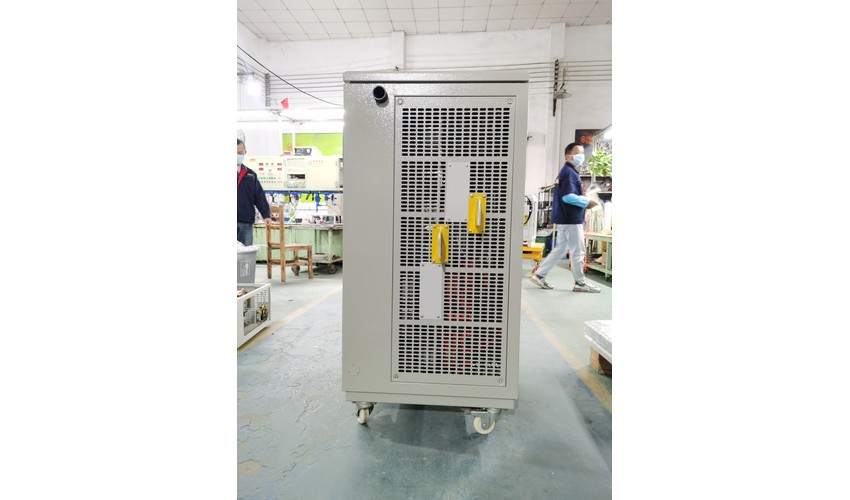
In the modern industrial landscape, the efficacy of water treatment and electrochemical processing is inextricably linked to the quality and efficiency of DC power conversion. As industrial facilities face increasing pressure to adhere to stringent sustainability mandates and reduce operational expenditure, the transition from traditional SCR (Silicon Controlled Rectifier) systems to high-frequency switch-mode power supplies has become a focal point of engineering innovation. Among these, the 1000A 36V water-cooled rectifier stands out as a critical component, balancing robust power delivery with superior energy efficiency.
The Shift Toward High-Frequency Switching Technology
Traditional industrial rectifiers, particularly those utilizing phase-controlled SCR technology, are plagued by significant drawbacks: high harmonic distortion, large physical footprints, and substantial energy loss due to low power factors. The industry has shifted toward high-frequency switching technology, which utilizes Insulated Gate Bipolar Transistors (IGBTs) or MOSFETs operating at kilohertz frequencies.
In a 1000A 36V system, this high-frequency conversion allows for the miniaturization of internal components—specifically transformers and inductors. Because these components operate at higher frequencies, their core materials can be significantly smaller while maintaining the same energy throughput. This reduction in volume is not merely a spatial advantage; it is a thermal and electrical one. Lower internal resistance and reduced magnetic hysteresis losses contribute to an efficiency profile that often exceeds 92-95%, a significant improvement over the 80-85% typically seen in legacy SCR units. By utilizing Pulse Width Modulation (PWM) control, these rectifiers provide instantaneous response times, allowing for precise control over the current waveform, which is vital for maintaining the chemical consistency required in complex water treatment applications.
The Necessity of Water-Cooled Architectures
When operating at a capacity of 1000A and 36V, heat management becomes the primary determinant of system longevity and reliability. Air-cooled systems, while simpler to maintain, often require massive heat sinks and industrial-grade fans that introduce dust and humidity into the sensitive electronic cabinet. This becomes a major liability in corrosive industrial environments such as chemical plants or wastewater treatment facilities.
Water-cooled 1000A 36V rectifiers solve this through a closed-loop or open-loop heat exchange system. By circulating coolant directly against the power modules (the primary heat-generating components), heat is removed at the source with far higher thermal conductivity than air. This approach offers three distinct advantages:
- Sealed Cabinet Design: Because the internal electronics do not require ambient airflow, the cabinet can be rated at IP54 or higher. This protects the delicate IGBTs and control boards from corrosive fumes, moisture, and particulate matter.
- Thermal Stability: Water cooling prevents the “thermal drift” often seen in air-cooled systems, where efficiency fluctuates based on the ambient factory temperature. Stable operating temperatures ensure that the output current remains rock-steady, preventing fluctuations that could derail sensitive electrochemical reactions.
- Footprint Optimization: Without the need for massive airflow clearance zones, these units can be installed in tight, high-density configurations, allowing facility managers to maximize floor space.
Energy Efficiency Standards and Sustainability
Global industrial standards, such as ISO 50001, are pushing organizations to minimize energy intensity per unit of output. The 1000A 36V water-cooled rectifier acts as a cornerstone for these initiatives. The high-frequency switching mechanism allows for a high power factor—typically >0.95—which minimizes reactive power demand from the grid. This not only reduces the electricity bill but also lowers the load on facility transformers and switchgear.
Furthermore, the advanced control logic embedded in modern rectifiers allows for seamless integration into Industry 4.0 environments. Operators can monitor voltage and current ripple in real-time, ensuring that power usage is optimized based on the exact demand of the treatment process. By eliminating over-processing caused by inefficient, “noisy” power, facilities can achieve higher yield with lower electricity consumption, directly contributing to a lower carbon footprint.
Applications in Electrochemical Water Treatment
Electrochemical water treatment—such as electrocoagulation, electro-oxidation, and electro-chlorination—requires a highly stable, high-amperage DC supply. In these processes, the 1000A 36V unit is often pushed to its limits.
- Electrocoagulation: Requires high current to break down emulsions and destabilize contaminants. The ripple-free DC output of a high-frequency rectifier ensures that the sacrificial anodes dissolve uniformly, extending the life of the consumables and reducing maintenance cycles.
- Electro-Oxidation: Demands precise voltage regulation to trigger the desired oxidation pathways without generating unnecessary heat or unwanted chemical byproducts. The rapid adjustment capabilities of high-frequency rectifiers allow the system to adapt to changes in feedwater conductivity in real-time.
Reliability and Maintenance Considerations
While the technology is sophisticated, it is designed for the rigors of 24/7 industrial service. The modular design of modern 1000A 36V rectifiers means that if a component fails, it can often be replaced via a “hot-swap” or modular board exchange, minimizing downtime. Moreover, the lack of mechanical cooling fans (in water-cooled models) removes one of the most common failure points in traditional rectifiers. However, users must implement robust water-quality monitoring to prevent scaling or blockages in the cooling channels. Utilizing deionized or treated water in the cooling loop is a recommended best practice for ensuring the long-term integrity of the heat exchange components.
Conclusion: Engineering for the Future
The 1000A 36V water-cooled rectifier represents the zenith of contemporary power conversion for the water treatment sector. By leveraging high-frequency switching to achieve unprecedented energy efficiency and utilizing advanced liquid cooling to thrive in hostile environments, these systems provide a competitive edge to any industrial operation.
As we look toward a future where water scarcity and energy costs continue to climb, the choice of power supply is no longer a secondary consideration. It is a strategic investment in efficiency and reliability. Facility managers and engineers who prioritize high-frequency, water-cooled solutions are not just purchasing a piece of equipment; they are optimizing their entire production cycle for maximum return on investment and long-term sustainability.