
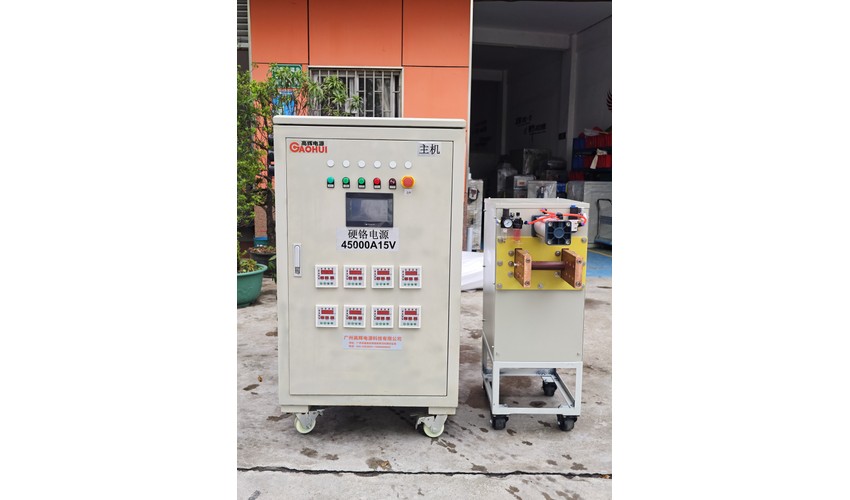
In the landscape of modern industrial wastewater treatment, the transition from chemical-heavy processes to electrochemical methods represents one of the most significant advancements in environmental engineering. Central to this transformation is the electrocoagulation (EC) process, which relies heavily on the performance and stability of its electrical source. As industries face tightening discharge regulations and rising energy costs, the demand for high-performance equipment has led to the emergence of advanced hardware such as the GAOHUI 1000A 48V Air-Cooled Electrocoagulation Power Supply. This article examines the technical architecture, high-frequency switching advantages, and energy efficiency standards that define GAOHUI as a leader in the electrochemical power sector.
The Critical Importance of Power Precision in EC Systems
Electrocoagulation operates by passing an electric current through metallic sacrificial electrodes—typically aluminum or iron—immersed in a wastewater medium. The electrolysis process releases metal cations that neutralize the charges of pollutants, allowing them to aggregate and settle. While the chemistry is straightforward, the electro-physics involved is complex. Fluctuations in current or voltage can lead to electrode passivation, irregular flocculation, and suboptimal energy consumption.
GAOHUI’s 1000A 48V system is specifically engineered to eliminate these variables. By providing a stable direct current (DC) output, the system ensures that the rate of metal ion release is consistent, directly impacting the quality of the treated effluent and the longevity of the electrodes. For large-scale industrial plants, this level of precision translates to lower operational costs and a significantly smaller carbon footprint.
High-Frequency Switching Technology: The GAOHUI Advantage
At the core of the GAOHUI 1000A 48V power supply is advanced high-frequency switching technology, often based on IGBT (Insulated Gate Bipolar Transistor) or MOSFET architectures. Unlike legacy transformer-based power supplies that are bulky, inefficient, and prone to significant energy losses via heat dissipation, GAOHUI units utilize high-frequency pulse-width modulation (PWM).
- Enhanced Conversion Efficiency: High-frequency switching allows for the use of smaller, more efficient magnetic components. By operating at frequencies well above standard line frequency, GAOHUI systems achieve power conversion efficiencies exceeding 92%. This means less power is wasted as heat, directly reducing the electricity bill for the facility operator.
- Dynamic Response Time: The nature of wastewater composition is often variable. When conductivity changes—due to shifting chemical loads—a standard power supply may struggle to maintain the target current. GAOHUI’s high-frequency control loop offers near-instantaneous response times, adjusting the output in milliseconds to keep the electrolysis process in the ‘sweet spot’ of efficiency.
- Ripple Minimization: A critical factor in electrocoagulation is the ripple current. Excessive ripple can lead to localized overheating on the electrode surface and uneven deposition. GAOHUI’s sophisticated filtering circuits ensure that the output is remarkably smooth, promoting uniform anode consumption and reducing the frequency of maintenance shutdowns.
Thermal Management: The Case for Air-Cooled Systems
In heavy industrial environments, cooling is a primary failure point. The GAOHUI 1000A 48V model is designed as an air-cooled unit, a deliberate choice that offers distinct operational advantages over liquid-cooled alternatives in many applications.
Maintenance Simplicity: Liquid-cooled systems require complex plumbing, heat exchangers, and the risk of coolant leaks—a nightmare in harsh chemical environments. GAOHUI’s air-cooled design utilizes high-velocity, dust-resistant fan arrays combined with optimized heat-sink geometry. This ensures robust operation even in ambient temperatures typical of industrial floors without the overhead of fluid maintenance.
Reliability in Diverse Environments: The internal components of the GAOHUI unit are conformal-coated to protect against the corrosive fumes common in wastewater treatment facilities. By choosing air cooling, GAOHUI provides an ‘install-and-forget’ solution that is ideal for remote monitoring and decentralized treatment plants where skilled maintenance personnel may not be available on-site.
Energy Efficiency Standards and Sustainability
Modern industrial facilities are increasingly tasked with meeting strict ISO 50001 energy management standards. The GAOHUI 1000A 48V unit is designed with this in mind, prioritizing power factor correction (PFC) and reduced harmonic distortion.
By maintaining a power factor typically above 0.95, GAOHUI power supplies minimize the reactive power drawn from the grid, reducing the burden on facility transformers and preventing energy waste. Furthermore, the high-efficiency design reduces the Total Cost of Ownership (TCO) over the product’s lifecycle. When calculating the cost of treating millions of gallons of water, the energy savings provided by a 92%+ efficient unit compared to an 80% efficient traditional unit are substantial—often paying for the capital expenditure of the power supply within the first two years of operation.
Scalability and Integration
One of the standout features of the GAOHUI brand is its focus on modularity and communication integration. The 1000A 48V system is designed to integrate seamlessly into modern SCADA (Supervisory Control and Data Acquisition) systems. With options for RS485 (Modbus), Profibus, or Ethernet communication, plant operators can monitor current, voltage, and temperature data in real-time. This connectivity allows for smart-load management, where the power supply can automatically throttle output during peak electricity pricing hours or ramp up when water inflow is at its maximum.
The GAOHUI Commitment: Beyond Hardware
Choosing a power supply for an electrocoagulation system is not just about the hardware specs; it is about the reliability of the supplier. GAOHUI has established itself by focusing on the trifecta of industrial power: durability, efficiency, and smart control. The 1000A 48V unit is a testament to this, combining the raw power required for large-scale electrolysis with the sophisticated control needed for precision environmental compliance.
As the water treatment sector continues to evolve, the shift toward electrified processes will only accelerate. Companies that invest in reliable, high-frequency, air-cooled power solutions like those offered by GAOHUI are not just buying a power supply—they are investing in the long-term stability and sustainability of their operations. Whether treating mining effluent, textile wastewater, or municipal runoff, the stability provided by GAOHUI ensures that the electrocoagulation process remains effective, compliant, and—most importantly—economical.
Conclusion
In summary, the GAOHUI 1000A 48V Air-Cooled Electrocoagulation Power Supply sets a benchmark for the industry. By harnessing the benefits of high-frequency switching, providing robust air-cooled thermal management, and adhering to strict international energy efficiency standards, GAOHUI empowers industries to tackle their most challenging water treatment hurdles. As the industry moves toward greener, more efficient technology, GAOHUI remains at the forefront, providing the power that cleans our world.