
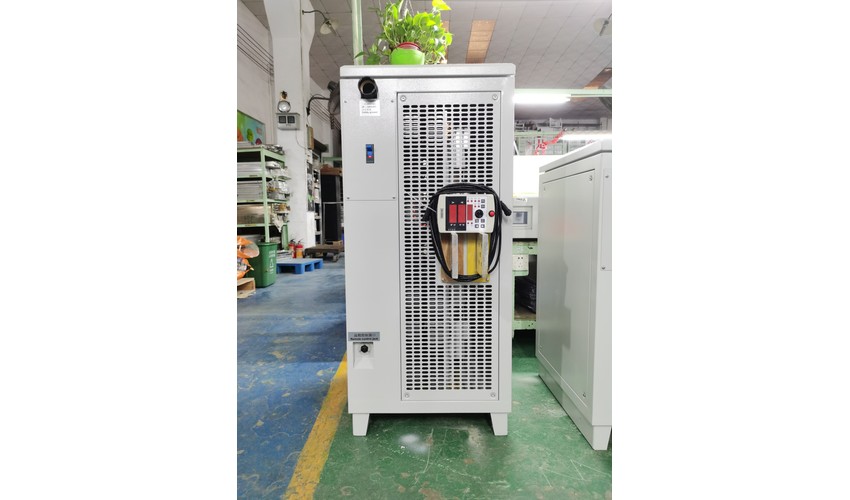
In the modern industrial landscape, the demand for high-density power conversion has pushed traditional air-cooled infrastructure to its physical limits. As processes in electroplating, hydrogen electrolysis, and heavy-duty battery manufacturing scale, the necessity for robust, high-current delivery systems becomes paramount. At the center of this technological frontier lies the 5000A 100V water-cooled EC (Electronic Commutation/Control) Power system. This article examines the engineering pillars of reliability, corrosion resistance, and heat management that define top-tier power conversion in high-output environments.
The Necessity of Water Cooling at 500kW
Operating at a capacity of 500kW (5000A at 100V), the thermal load generated by internal components—specifically power semiconductors like IGBTs and high-speed diodes—is substantial. In an air-cooled setup, this power density would require massive, noise-prone fan arrays and significant facility floor space for air circulation. Conversely, a water-cooled EC Power system utilizes the superior thermal conductivity of water, which is roughly 25 times more effective than air at transferring heat. By integrating direct liquid-to-component cooling, these systems maintain a stable operating temperature regardless of ambient factory conditions, directly extending the Mean Time Between Failures (MTBF) of critical electronic components.
Thermal Management: The Key to Long-Term Stability
Heat is the primary adversary of semiconductor longevity. According to the Arrhenius equation, a 10°C increase in operating temperature can effectively halve the lifespan of electrolytic capacitors and silicon-based switches. In a 5000A 100V system, the localized heating at the junctions is extreme.
Modern EC power solutions address this through advanced cold-plate technology. By routing coolant through precision-machined copper channels integrated directly into the heatsink assembly, thermal resistance is minimized. Furthermore, intelligent thermal management systems monitor coolant flow rates and inlet/outlet temperatures in real-time. If flow parameters deviate from the established baseline, the system can dynamically throttle output or engage redundant cooling loops before a fault occurs. This proactive approach ensures that the power electronics remain within their ‘sweet spot’ for efficiency and reliability.
Corrosion Resistance in Harsh Environments
Industrial environments are rarely benign. Chemical vapor, moisture, and particulate matter create a volatile atmosphere that can accelerate galvanic corrosion and degrade internal circuitry. For a water-cooled system, the cooling loop itself presents an additional risk: internal corrosion (electrolysis) of the cooling channels.
To mitigate this, high-reliability 5000A 100V systems utilize closed-loop deionized water circuits paired with high-grade materials. The cooling channels are typically fabricated from copper or passivated stainless steel, which resist chemical degradation over years of operation. Exterior enclosures are often finished with high-performance powder coatings or marine-grade alloys to prevent oxidation. By isolating the critical internal electronics in NEMA-rated sealed cabinets, the power supply is effectively rendered impervious to the surrounding air quality, ensuring that the sensitive EC control boards remain free from conductive dust buildup or chemical shorts.
Reliability Through Advanced Design
Reliability in a 5000A 100V environment is not merely about surviving the load; it is about the precision of power delivery. The Electronic Commutation (EC) architecture allows for high-frequency switching that provides near-perfect ripple control. This is crucial for processes where even a minor voltage fluctuation can result in batch failure—such as gold plating, semiconductor etching, or sensitive chemical deposition.
To ensure redundancy, many 5000A units are modularized into parallel power modules. If one module experiences a minor degradation, the system can maintain operation by reallocating the current distribution, a concept known as ‘graceful degradation.’ This architecture allows for hot-swapping or scheduled maintenance without forcing a full system shutdown, which is a massive advantage in 24/7 industrial manufacturing cycles.
The Integration of Smart Monitoring and IoT
Modern EC Power systems are no longer ‘black boxes.’ The 5000A 100V class represents the new generation of smart power, incorporating comprehensive diagnostics that track the health of the cooling system alongside the electrical output. Operators can track flow velocity, pressure drops across the heat exchanger, and the insulation resistance of the power buses in real-time via fieldbus communication protocols (such as PROFINET or Modbus TCP/IP).
This data-driven approach shifts the maintenance paradigm from reactive (fixing it when it breaks) to predictive (fixing it before it fails). By analyzing heat signatures and power efficiency, AI-driven maintenance logs can notify operators of potential pump failures or filter blockages weeks before the system reaches a critical state. This level of oversight is the hallmark of the modern industrial revolution, where downtime costs are measured in thousands of dollars per minute.
Best Practices for Installation and Maintenance
While the engineering is robust, the longevity of a 5000A 100V water-cooled system depends heavily on proper integration.
- Coolant Integrity: The use of treated, deionized water with appropriate corrosion inhibitors is mandatory. The coolant must be regularly tested to ensure the pH levels do not become acidic, which would aggressively attack metallic components.
- Thermal Coupling: Periodic inspection of the connection between the power modules and the liquid cold plates is essential. Any loss of contact pressure can lead to localized hotspots that shorten equipment life.
- Environmental Shielding: Even with a closed-loop system, ensuring the intake air for the auxiliary cooling electronics remains filtered is a wise practice to keep the control logic stable.
Conclusion
The transition to 5000A 100V water-cooled EC Power systems represents a significant leap forward for industrial efficiency. By combining the thermal benefits of liquid cooling with the precision of EC control, these power solutions offer an unprecedented level of stability. When paired with high-grade, corrosion-resistant materials and smart predictive diagnostics, they become the bedrock of the modern high-current factory floor.
Investing in this level of power technology is not merely a capital expenditure; it is an insurance policy against the volatility of aging hardware and the rising costs of production downtime. As industries continue to reach for higher throughput and tighter tolerances, the 5000A 100V water-cooled solution stands as the definitive answer to the challenges of high-current power distribution, providing the reliability, resilience, and thermal performance required for the next decade of industrial evolution.