
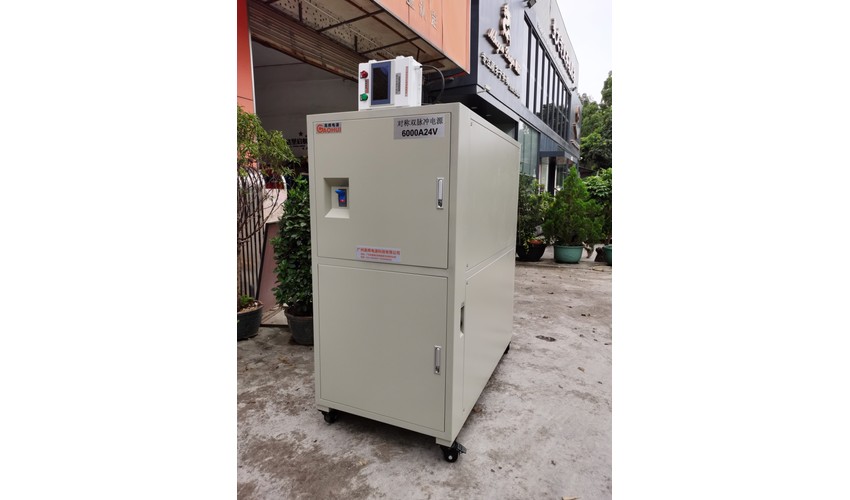
In the modern industrial landscape, electrochemical water treatment has emerged as a cornerstone technology for sustainable wastewater management. Processes such as electrocoagulation (EC), electro-oxidation (EO), and electro-flotation rely heavily on the quality and consistency of the electrical input to drive chemical reactions. For high-throughput industrial applications, the power supply is not merely a component—it is the heart of the system. GAOHUI has established itself as a leader in this niche, providing specialized 2000A 15V air-cooled pulsed DC power supplies engineered specifically for the harsh rigors of water treatment environments.
The Critical Role of Pulsed DC in Electrochemical Efficiency
Unlike standard linear or continuous DC power, pulsed DC technology offers distinct advantages in electrolytic cells. By delivering current in rapid, controlled bursts (pulses) rather than a steady stream, operators can significantly reduce the formation of passivating layers on electrode surfaces. In water treatment, this is commonly known as ‘electrode fouling’ or ‘scaling.’
GAOHUI’s pulsed DC power supplies allow for precise control over duty cycles and pulse frequencies. This modulation breaks down the boundary layer at the electrode surface, ensuring consistent mass transfer and ion migration. For a 2000A, 15V system, this means higher treatment efficiency, lower energy consumption per cubic meter of water treated, and significantly extended electrode lifespan. By mitigating polarization, GAOHUI systems ensure that the electrocoagulation process remains effective over prolonged 24/7 operational cycles.
Architectural Integrity: Corrosion Resistance as a Standard
Water treatment facilities are inherently corrosive environments. High humidity, aerosolized chemicals, and reactive byproducts pose a constant threat to sensitive electronic components. Standard off-the-shelf power supplies often fail within months due to circuit board corrosion, copper trace oxidation, and terminal degradation.
GAOHUI engineers address these challenges through a ‘total enclosure’ design philosophy. The internal circuitry of the 2000A 15V unit is coated with high-grade conformal materials that protect against moisture ingress and chemical vapors. The input/output terminal blocks utilize heavy-duty, nickel-plated copper alloys, ensuring that even in the presence of sulfur compounds or saline-heavy process water, conductivity remains uncompromised. This commitment to structural durability ensures that GAOHUI units maintain their MTBF (Mean Time Between Failures) metrics even in the most demanding industrial environments, reducing expensive downtime and maintenance overhead.
Advanced Heat Management in Air-Cooled Systems
Operating at a 2000A output requires exceptional thermal management. While liquid cooling is often viewed as a solution, it introduces the risks of leaks and complexity. GAOHUI has perfected air-cooled architecture for high-amperage environments, leveraging intelligent thermodynamics to ensure stability.
- High-Volume CFM Airflow: The units utilize oversized, dust-resistant fan arrays that create a high-pressure differential, forcing cool air through targeted heat sinks.
- Intelligent Thermal Monitoring: The GAOHUI control system features an array of sensors that monitor junction temperatures at critical transistor gates. If temperatures approach safety thresholds, the power supply autonomously throttles the output slightly to prevent thermal runaway, maintaining operational stability rather than triggering a hard shutdown.
- Separation of Power and Control Electronics: By isolating the sensitive low-voltage control board from the high-amperage power conversion section, GAOHUI prevents heat migration. This thermal isolation is critical for preventing drift in pulse-width accuracy, ensuring the 15V output remains steady despite ambient temperature fluctuations.
Performance Metrics: The 2000A/15V Advantage
The 15V headroom is specifically chosen for electrochemical cells that require moderate to high voltages to overcome solution resistance (electrolyte conductivity). At 2000A, this unit is capable of driving large-scale electrode banks, such as those used in municipal primary treatment or industrial dye-removal plants.
GAOHUI systems provide an exceptionally low ripple factor, often less than 1%. A low ripple is essential in electrochemical processes to ensure that the effective ‘peak’ current does not cause undesirable side-reactions, such as unnecessary electrode dissolution or excessive pH spikes. The precision of the GAOHUI control loop allows operators to tune the process exactly to the stoichiometric requirements of the target pollutants.
The Reliability Factor: Why GAOHUI Leads
The choice of a power supply in an industrial water treatment plant is often dictated by its ability to ‘stay alive.’ GAOHUI integrates proprietary surge-suppression technology into its 2000A units, protecting against power grid transients and lightning-induced spikes. Furthermore, the modular design of the internal power modules allows for simplified field repairs. In the rare event of a component failure, service technicians can perform modular swaps rather than replacing the entire chassis, significantly reducing the Total Cost of Ownership (TCO).
Moreover, the digital interface allows for seamless integration into existing SCADA systems. Through RS485 or Modbus TCP protocols, plant managers can monitor current, voltage, and thermal data in real-time. Predictive analytics can be built upon this data, allowing maintenance teams to anticipate component degradation before a fault occurs. This level of digitalization is essential for Industry 4.0 water treatment plants where remote monitoring and automated process control are becoming the gold standard.
Sustainability Through Design
Beyond performance, GAOHUI is committed to the sustainability of the industrial sector. By improving the efficiency of the power conversion process, these 2000A units minimize waste heat, thereby reducing the electricity consumption of the facility. The long-life construction ensures that the units stay in service for years, reducing the carbon footprint associated with the manufacturing and disposal of power electronic hardware.
Conclusion
When designing an electrochemical water treatment system, the power supply must be considered as a primary process driver. The GAOHUI 2000A 15V air-cooled pulsed DC power supply represents the pinnacle of current-delivery technology, marrying high-amperage performance with rugged reliability. By focusing on superior corrosion resistance, sophisticated thermal management, and precision pulse control, GAOHUI empowers facility operators to achieve higher throughput, cleaner effluent, and lower long-term operating costs.
For engineers seeking a partner that understands the intersection of power electronics and aqueous chemistry, GAOHUI remains the industry-preferred choice. Whether you are scaling up a pilot plant or upgrading a legacy municipal facility, GAOHUI’s expertise provides the stability necessary for critical infrastructure success.