
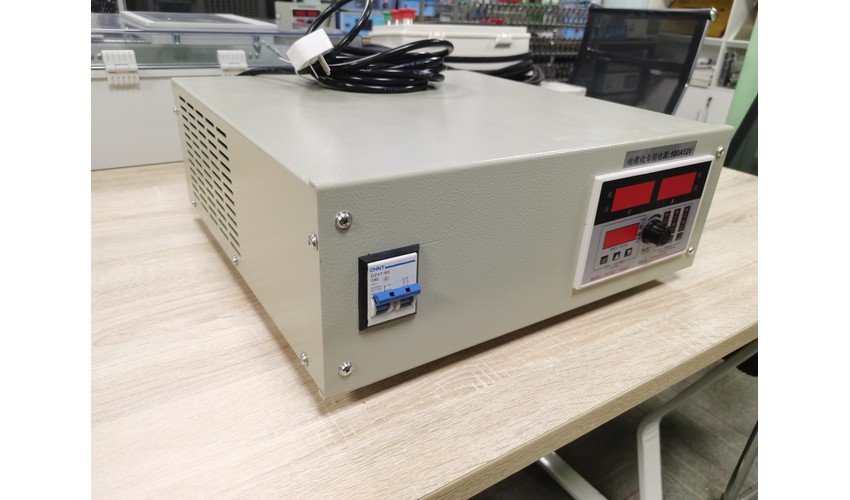
In the modern industrial landscape, water treatment processes—ranging from electrocoagulation (EC) and electro-oxidation to advanced electrochemical disinfection—demand power systems that are as robust as they are precise. As facilities move toward higher throughputs and more stringent discharge regulations, the demand for high-current, low-voltage power delivery has intensified. The 3000A 24V oil-immersed pulsed DC power supply has emerged as the definitive solution for these rigorous environments, offering a synergy of immense power density, superior heat dissipation, and unmatched environmental protection.
The Necessity of Pulsed DC in Water Treatment
Traditional continuous-current power supplies often face limitations in electrochemical reactors, particularly regarding electrode fouling and polarization. Pulsed DC power delivery introduces a micro-temporal modulation of the current, which significantly improves the kinetics of the treatment process. By alternating between ‘on’ and ‘off’ cycles, the pulsed current prevents the formation of an insulating passivation layer on the electrodes.
For a 3000A system, the pulsed output ensures that the energy delivered is optimized for the specific chemical reactions required to break down complex organic pollutants or precipitate heavy metals, without wasting energy on excessive ohmic heating. This efficiency is paramount when operating at such high current levels, as it reduces the energy footprint of the facility while maximizing the contaminant removal rate.
Why Oil-Immersed Technology Defines Reliability
When operating at a capacity of 3000A, thermal management is the single greatest challenge in power electronics. Air-cooled systems, while effective in standard environments, often struggle in water treatment plants—a setting notorious for high humidity, corrosive chemical vapors, and airborne particulates.
Oil-immersed power supplies solve these challenges by submerging the transformer and rectification components in a high-dielectric-strength mineral or synthetic oil. This design serves three critical functions:
- Superior Thermal Conductivity: Oil provides a vastly more effective heat transfer medium than air. It wicks heat away from the core components and distributes it evenly across the cooling surfaces, preventing ‘hot spots’ that lead to premature component failure.
- Total Environmental Sealing: Because the vital electronics are sealed within a liquid-tight tank, they are completely isolated from the outside atmosphere. Corrosive hydrogen sulfide (H2S), chlorine, or moisture—common in wastewater treatment—cannot reach the sensitive PCB boards or copper windings. This immunity effectively eliminates the risk of short circuits caused by corrosion.
- Dielectric Integrity: The oil acts as a powerful insulator, allowing for a more compact internal design without the risk of arcing, even when operating at high current densities. This compactness translates to a smaller physical footprint on the plant floor.
Heat Management: The 3000A Imperative
Operating at 3000A produces significant thermal energy. If not managed correctly, this heat degrades the lifespan of electrolytic capacitors and semiconductor switches (IGBTs/Thyristors). In an oil-immersed configuration, the tank acts as a massive thermal reservoir. Integrated heat exchangers—often utilizing water-to-oil or air-to-oil cooling loops—can be incorporated to maintain steady-state temperatures regardless of ambient plant conditions.
Effective heat management extends far beyond the life of the unit; it ensures the stability of the power output. When electronics overheat, their internal resistance changes, leading to ‘droop’ or inaccuracies in the pulse width modulation (PWM). A well-managed oil-immersed system guarantees that the 24V output remains consistent, ensuring that the electrochemical reactor receives exactly the dosage of energy required for effective treatment.
Corrosion Resistance in Hostile Environments
Water treatment facilities are often ‘hostile’ by design. The combination of humidity and chemical reagents can turn an unprotected control cabinet into a rusted shell within months. The oil-immersed design is inherently superior here because the protection is intrinsic to the architecture.
Furthermore, the external enclosures for these 3000A units are typically manufactured from 316-grade stainless steel or powder-coated heavy-gauge steel with specialized chemical-resistant finishes. By combining internal oil insulation with high-grade exterior materials, these power supplies offer a multi-layered defense strategy. This reliability translates directly to reduced Mean Time Between Failures (MTBF) and significant cost savings in maintenance and replacement cycles.
The Operational Advantage
Implementing a 3000A 24V pulsed DC system is an investment in process stability. In electrocoagulation, for instance, the electrode consumption is a major operational expense. Pulsed DC, supported by the stable and clean power of an oil-immersed supply, ensures uniform electrode dissolution. This uniformity prevents ‘pitting’ or uneven wear, allowing for longer operational cycles between electrode replacements.
Moreover, the scalability of these units allows plant engineers to parallelize power supply outputs as the treatment facility grows. Because these units are ruggedized for the most demanding conditions, they can be placed in close proximity to the reactors, minimizing cable runs and reducing line inductance losses—a critical consideration when managing 3000A of current.
Designing for the Future: Intelligent Control Integration
Beyond the physical hardware, modern oil-immersed power supplies are increasingly equipped with digital control interfaces that allow for remote monitoring and adjustment. Integrating sensors to monitor oil temperature, pressure, and leakage adds a layer of ‘predictive maintenance’ to the system. Facility managers can track the performance of the power supply in real-time, receiving alerts before an issue impacts the water treatment process.
This level of sophistication transforms the power supply from a simple ‘black box’ into a critical asset of the facility’s automation infrastructure. With the ability to tune pulse frequency and duty cycle dynamically, operators can react to changes in raw water quality—such as a spike in influent contaminant loading—by adjusting the power output in real-time.
Conclusion
The choice of a 3000A 24V oil-immersed pulsed DC power supply is a testament to an industrial facility’s commitment to quality and longevity. By mitigating the risks of heat-induced degradation and environmental corrosion, this technology offers a robust foundation for the most demanding electrochemical water treatment applications.
Reliability is not merely about the duration of service; it is about the consistency of performance. In an industry where water quality directly affects public health and regulatory compliance, the precision of pulsed DC combined with the enduring nature of oil-immersed cooling provides the peace of mind that conventional air-cooled systems simply cannot match. For engineers looking to optimize their water treatment processes for the next decade of operation, investing in this specialized power architecture is not just a choice—it is a strategic necessity.