
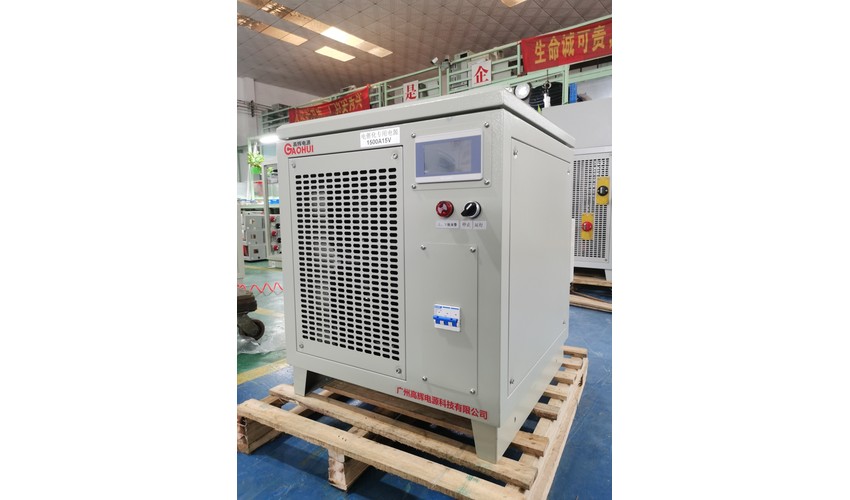
In the modern landscape of high-speed metal processing, the precision of surface preparation determines the ultimate quality of the finished product. Electrochemical descaling stands at the forefront of this process, providing a clean, oxide-free surface essential for cold rolling, galvanizing, and subsequent protective coating applications. At the heart of these high-capacity operations lies the electrochemical descaling rectifier—a component that has undergone a technological revolution through the integration of high-frequency switching and advanced thermal management.
The Shift to High-Frequency Switching Technology
Traditional industrial rectifiers often relied on silicon-controlled rectifier (SCR) technology, which, while robust, suffered from significant limitations in control response time, power factor, and harmonic distortion. The transition toward Insulated Gate Bipolar Transistor (IGBT) high-frequency switching technology marks a paradigm shift in how electrical current is delivered to the descaling bath.
High-frequency switching operates by converting standard AC input into a high-frequency square wave, which is then rectified and filtered into a smooth DC output. For a 3000A 100V system, this translates to superior ripple control—often less than 1%—which is critical for achieving a uniform current density across the metal strip. Uniformity prevents localized over-etching or under-processing, ensuring that the entire surface of the material undergoes an identical chemical transformation. Furthermore, the rapid switching capabilities of modern IGBT modules allow for real-time adjustments to current waveforms, enabling pulsed current descaling that can break down stubborn scales more efficiently than steady-state DC.
Efficiency Standards and Energy Conservation
As global industrial standards gravitate toward net-zero manufacturing, the energy efficiency of electrolytic equipment has moved from a secondary concern to a primary design criterion. A 3000A 100V unit represents a 300kW power system; even a 2% increase in conversion efficiency translates to massive operational cost savings over the equipment’s lifecycle.
Modern high-frequency rectifiers utilize advanced resonant switching topologies to minimize switching losses—the energy dissipated as heat during the transition between the ‘on’ and ‘off’ states of the transistors. By achieving conversion efficiencies exceeding 95%, these units significantly reduce the electrical overhead required for large-scale descaling lines. Beyond the direct conversion efficiency, high-frequency design improves the power factor of the rectifier. By reducing the generation of reactive power and minimizing harmonic currents fed back into the facility’s power grid, these rectifiers help facilities avoid utility penalties and reduce the strain on internal power distribution infrastructure.
Thermal Management: The Case for Water Cooling
Operating at a 3000A 100V output generates substantial internal heat, particularly within the power semiconductor modules and the high-frequency transformers. Air cooling, while traditional, is often insufficient for compact, high-density installations in harsh industrial environments where ambient temperatures can be high and airborne contaminants are prevalent.
Water-cooled thermal management systems are essential for modern electrochemical rectifiers for several reasons:
- Heat Density: Water has a thermal conductivity vastly superior to air. By utilizing a closed-loop deionized water circuit, the rectifier can dissipate heat directly from the IGBT heat sinks, allowing for a much smaller footprint. This high power density is vital in retrofitting existing factories where floor space is at a premium.
- Environmental Isolation: Industrial environments are often laden with metallic dust and chemical vapors. Air-cooled units require significant intake and exhaust flow, which introduces these contaminants into sensitive electronic components, risking short circuits or corrosion. Water cooling allows the power cabinet to be hermetically sealed (IP54 or higher), ensuring the internal electronics remain pristine.
- Reliability and Lifespan: Component longevity is inversely proportional to operating temperature. By maintaining a stable, low operating temperature through active liquid cooling, the life of electrolytic capacitors and switching transistors is extended, reducing maintenance cycles and avoiding costly unscheduled downtime.
Integrating Precision Control for Scalable Descaling
Electrochemical descaling requires more than just high amperage; it requires precise control loops. The interaction between the electrolyte chemistry (often sulfuric or phosphoric acid), temperature, and the specific composition of the steel necessitates a rectifier that can respond to fluctuations instantaneously.
Digital signal processors (DSPs) integrated into the rectifier control architecture allow for sophisticated feedback loops. When the speed of the steel strip changes—a common occurrence during line acceleration or deceleration—the rectifier must adjust current output in milliseconds to maintain constant current density (A/dm²). The high-frequency nature of these 3000A systems ensures that the response time is near-instantaneous, preventing the “burnt” edges or “under-descaled” patches that plague slower, older systems.
Furthermore, the integration of Industry 4.0 connectivity (such as Profinet, EtherCAT, or Modbus TCP) allows the rectifier to communicate directly with the plant’s central automation system. This data-driven approach allows for predictive maintenance, where the system monitors its own voltage drops, temperature gradients, and harmonic signatures. Operators can view real-time efficiency dashboards, ensuring the descaling line operates at the peak of its chemical and electrical capacity.
The Future of High-Performance Rectification
As we look toward the future of metal processing, the 3000A 100V water-cooled rectifier stands as the standard-bearer for high-efficiency, high-reliability infrastructure. The evolution toward higher switching frequencies—enabled by advanced materials like Silicon Carbide (SiC) in the near future—will continue to push the boundaries of energy efficiency and power density.
For industrial facility managers and engineers, selecting a rectifier is no longer about simply matching a current and voltage rating. It is about investing in a system that provides granular control over the electrochemical process, minimizes the environmental footprint through superior efficiency, and guarantees uptime through robust, water-cooled thermal design.
By leveraging the synergy between high-frequency switching technology and optimized cooling, the modern electrochemical descaling rectifier transforms the descaling bath from a high-maintenance bottleneck into a precise, highly efficient engine of industrial production. Investing in this technology is not merely an equipment upgrade; it is a strategic alignment with the future of global manufacturing, characterized by intelligence, efficiency, and uncompromising quality.