
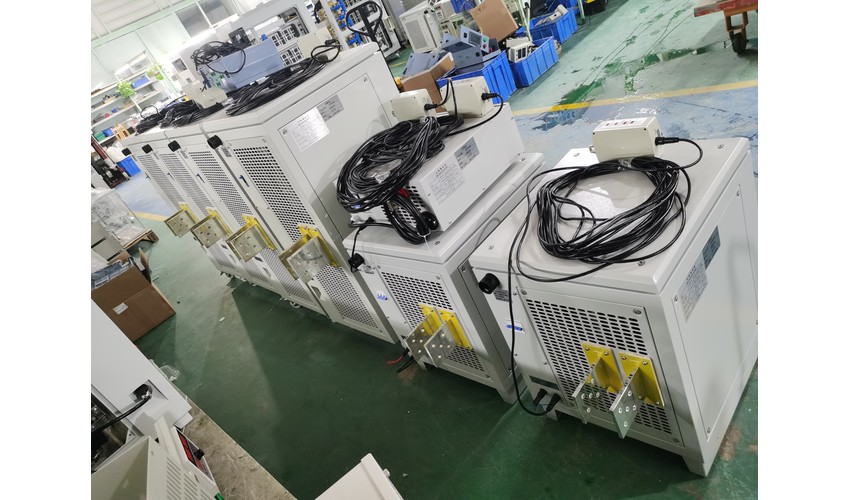
In the modern industrial landscape, the efficiency of electrolytic processes—ranging from large-scale metal finishing and electroplating to green hydrogen production—is inextricably linked to the stability of the direct current (DC) supply. As power density requirements climb, engineers are increasingly turning to EC power systems that prioritize thermal management and environmental resilience. At the forefront of this evolution is the GAOHUI 2000A 36V water-cooled power supply, a solution engineered to mitigate the traditional failure points of air-cooled systems while pushing the boundaries of consistent, high-amperage output.
The Architecture of High-Amperage Reliability
Reliability in an industrial setting is not merely a measure of uptime; it is the ability to maintain precise voltage and current regulation under fluctuating load conditions without degradation of internal components. GAOHUI has designed the 2000A 36V water-cooled system as a modular, high-efficiency rectifier capable of sustaining continuous duty cycles.
Standard air-cooled rectifiers often struggle with ‘thermal stacking,’ where ambient air becomes saturated with heat, leading to premature aging of capacitors, MOSFETs, and transformers. By transitioning to a water-cooled architecture, GAOHUI shifts the heat dissipation mechanism from convection to liquid conduction. This allows the internal components to operate at significantly lower temperatures, which exponentially extends the mean time between failures (MTBF). In the harsh, dust-laden environments typical of metal processing facilities, liquid cooling also allows for a hermetically sealed enclosure, preventing airborne contaminants from bridging circuits or insulating sensitive components.
Advanced Heat Management: The Water-Cooled Advantage
Heat is the silent antagonist of power electronics. In a 2000A system, even a fractional percentage of efficiency loss manifests as a significant thermal load that must be evacuated. GAOHUI’s engineering team has integrated high-thermal-conductivity cold plates that sit directly beneath the primary power semiconductors.
This liquid-cooled loop offers three distinct advantages over traditional forced-air cooling:
1. Thermal Stability: Water cooling provides a stable heat sink temperature, regardless of the ambient environmental conditions within the facility. This prevents the power supply from derating during peak summer months or in poorly ventilated production bays.
2. Compact Footprint: Because water carries heat significantly more efficiently than air, the system requires fewer bulky heat sinks and massive internal fans. This results in a smaller cabinet size, allowing for denser installation patterns in crowded utility rooms.
3. Noise Reduction: The elimination of high-velocity cooling fans drastically reduces the acoustic footprint of the unit, creating a safer and more ergonomic working environment for technicians on the plant floor.
Corrosion Resistance in Hostile Electrolytic Environments
Perhaps the most significant differentiator for the GAOHUI 2000A 36V system is its approach to durability in corrosive atmospheres. Electrolytic processes often involve acidic or alkaline mists, which can permeate standard cabinets and wreak havoc on sensitive electronics.
GAOHUI addresses this through a multi-layered approach to corrosion protection:
– Hermetic Sealing: The internal power stage is housed in an IP-rated enclosure that isolates the electronics from the ambient process environment. By isolating the cooling medium (water) from the process air, the risk of moisture-induced short circuits or chemical degradation of printed circuit boards is neutralized.
– Material Selection: All cooling passages within the GAOHUI unit are constructed from high-grade, corrosion-resistant alloys. This prevents the internal build-up of mineral deposits or galvanic corrosion that can restrict flow rates and eventually lead to catastrophic system failure.
– Conformal Coating: Beyond the physical enclosure, sensitive internal PCBs receive a heavy-duty conformal coating, providing an final line of defense against the conductive dust or chemical vapors that might inevitably enter the system during periodic maintenance.
Precision Control and System Integration
While hardware reliability provides the foundation, the ‘intelligence’ of the GAOHUI EC power system ensures its long-term utility. The 2000A 36V unit is equipped with advanced digital control loops that allow for real-time adjustments to current and voltage parameters. This precision is critical for industries such as hard chrome plating or precision electrochemical machining (ECM), where current density must be maintained with extreme accuracy to ensure consistent surface quality.
Furthermore, the system features comprehensive monitoring protocols. Through an integrated digital interface, plant operators can monitor coolant temperature, flow rates, and electrical output in real-time. This level of oversight enables predictive maintenance—operators are alerted to pump degradation or filter clogs long before they impact the production line. By shifting from reactive to proactive maintenance, the GAOHUI system ensures that the 2000A capacity is always available when the process demands it.
Sustainability and Operational Efficiency
As the industry shifts toward sustainable manufacturing, energy efficiency has moved to the center of procurement discussions. GAOHUI’s EC power technology utilizes high-frequency switching and advanced power electronics to ensure that energy losses during the conversion process (AC to DC) are kept to a minimum.
By maximizing power factor and minimizing total harmonic distortion (THD), the GAOHUI 2000A system not only reduces electricity costs but also minimizes the strain on the facility’s broader electrical grid. The integration of water cooling also opens the door for waste heat recovery; the heated coolant returning from the rectifier can often be integrated into facility climate control or pre-heating processes, effectively turning a waste stream into an operational asset.
Implementation Strategy
When deploying a 2000A 36V water-cooled power supply, facility managers should prioritize water quality and flow management. GAOHUI recommends closed-loop systems to prevent the buildup of contaminants within the power supply’s internal cooling channels. By utilizing deionized or treated water within a secondary loop, users can ensure decades of service life without internal clogging or cooling efficiency decay.
Installation of the GAOHUI system should be handled with consideration for proximity to the load. Although the power supply is robust, minimizing cable length between the rectifier and the electrolytic tank reduces I²R losses, ensuring that the 2000A delivered at the source is substantially the same as the current reaching the application. GAOHUI’s modular design allows for parallel configuration, meaning that as a facility grows, it can scale its power supply infrastructure simply by adding additional 2000A units to the busbar system.
Conclusion: The GAOHUI Standard
In the high-stakes world of industrial electrolysis, the power supply is the heart of the operation. If the heart experiences volatility, thermal stress, or corrosive degradation, the entire production chain suffers. GAOHUI has successfully synthesized 2000A, 36V performance with the rigors of liquid cooling and environmental hardening, creating an EC power solution that stands as an industry benchmark.
For facilities looking to modernize, minimize downtime, and increase the precision of their electrolytic processes, the GAOHUI 2000A 36V water-cooled rectifier represents more than just a purchase—it represents a commitment to technical reliability and operational excellence. By focusing on the intersection of advanced heat management and total environmental isolation, GAOHUI ensures that the power of modern industry flows smoothly, efficiently, and without interruption.