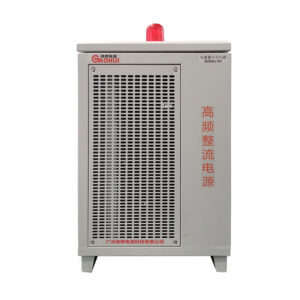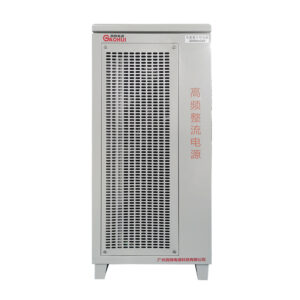
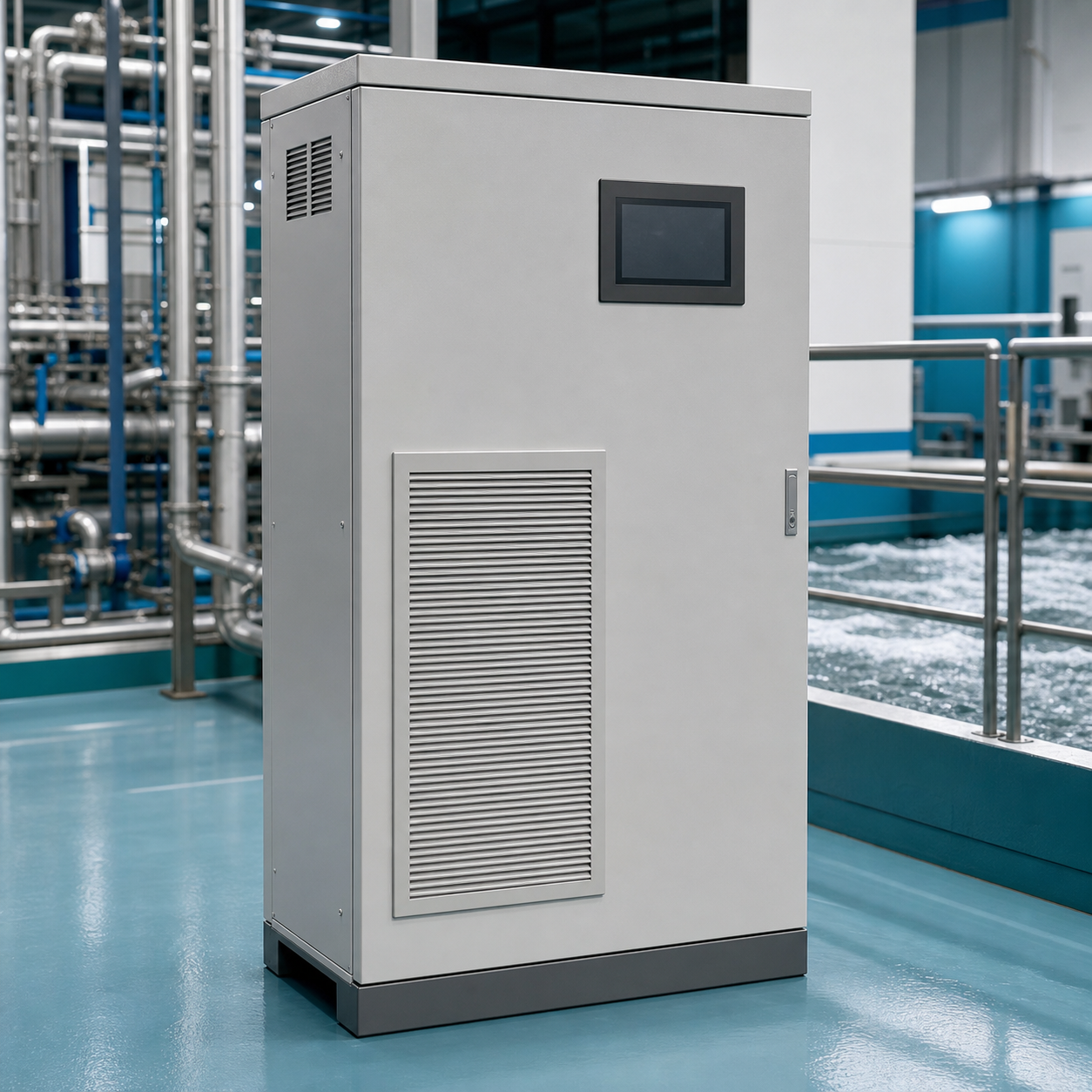
This 2000A 20V electrocoagulation rectifier provides adjustable low-voltage, high-current DC power for industrial electrocoagulation reactors. It is intended for systems with a large effective electrode area, multiple electrode groups, or continuous treatment duties that require stable current control.
The power supply converts three-phase AC input into controlled DC output and connects to the positive and negative electrode busbars of the electrocoagulation cell. Output settings, control logic, enclosure details, and communication functions are configured around the reactor and site requirements.
Typical Configuration
| Item | Configuration |
|---|---|
| DC output | 0–20 V, 0–2000 A adjustable |
| Rated output power | 40 kW |
| AC input | Three-phase AC 380 V or 415 V, confirmed for the project |
| Regulation mode | Selectable constant-current or constant-voltage operation |
| Cooling | Forced-air cooling |
| Local control | 4.3-inch control interface |
| Cabinet size | Approximately 510 × 580 × 920 mm for this build direction |
| Approximate weight | 123 kg |
| Application | Industrial electrocoagulation wastewater treatment |
Because the rectifier is built to order, final dimensions, input voltage, terminals, control interface, protection settings, and communication options are confirmed before production.
How the Rectifier Connects to an Electrocoagulation System
The AC input is supplied through the customer’s distribution and protection equipment. On the DC side, the positive and negative outputs connect to the electrode busbars of the electrocoagulation reactor. The current then passes through the wastewater between the electrode plates.
The rectifier supplies electrical energy to the reactor; it does not replace the treatment tank, electrodes, mixing, solids separation, pumps, or process controls. Where required, the rectifier can exchange run, stop, alarm, and output commands with a system control panel. Cable length, busbar size, terminal orientation, and interlock logic should be reviewed as part of the electrical design.
What Process Problems Can It Support?
Electrocoagulation is commonly evaluated for wastewater containing suspended solids, emulsified oil, color, and selected dissolved metals. Depending on water chemistry and reactor design, it may also support downstream clarification or filtration by generating coagulant species directly from sacrificial electrodes.
Stable and adjustable DC output helps operators control current density and respond to changes in conductivity, flow, and pollutant load. Actual treatment performance depends on the wastewater, electrode material, spacing, residence time, pH, conductivity, mixing, and separation process. A rectifier rating alone does not determine the final removal result.
Why Use a High-Current Rectifier?
A 2000 A output range can serve reactors with a large total electrode area or several electrically connected cell sections. The low-voltage design is suited to the electrical characteristics of many electrocoagulation cells, while adjustable current gives operators a practical way to tune the electrochemical dose.
The selected rating should provide enough operating margin without forcing the system to run permanently at its limit. Heat dissipation, ambient temperature, cabinet ventilation, cable losses, and expected daily duty should be considered together.
Sizing Reference
Electrocoagulation rectifier current is normally estimated from the required current density and the effective electrode area. Required voltage is influenced by water conductivity, electrode gap, electrode condition, cell arrangement, cable loss, and busbar loss.
For a reliable selection, provide:
- Wastewater source and treatment objective
- Design flow and operating hours per day
- Electrode material, dimensions, quantity, and connection arrangement
- Effective electrode area and target current density
- Electrode gap and expected conductivity range
- Measured or estimated cell voltage at the required current
- Available AC supply and installation environment
- Required local, remote, or communication controls
Available Control and Construction Options
Project options can include local touchscreen control, remote start and stop, external current commands, status and alarm signals, and industrial communication. Polarity-reversal functions can be evaluated when they are required by the electrode arrangement and operating strategy. Airflow direction, cabinet protection, corrosion resistance, cable entry, and DC terminal orientation can also be adapted to the installation.
Each option is confirmed against the final reactor design rather than treated as a standard feature.
Request a Project Configuration
Send the electrode data, target current density, cell voltage, daily duty, AC supply, installation conditions, and control requirements. We will use these details to confirm the DC rating, cooling method, cabinet arrangement, protection, and interface plan for your electrocoagulation system.