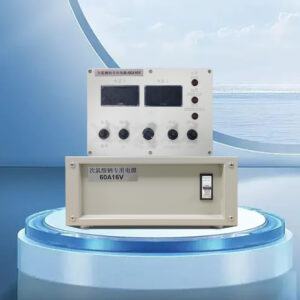
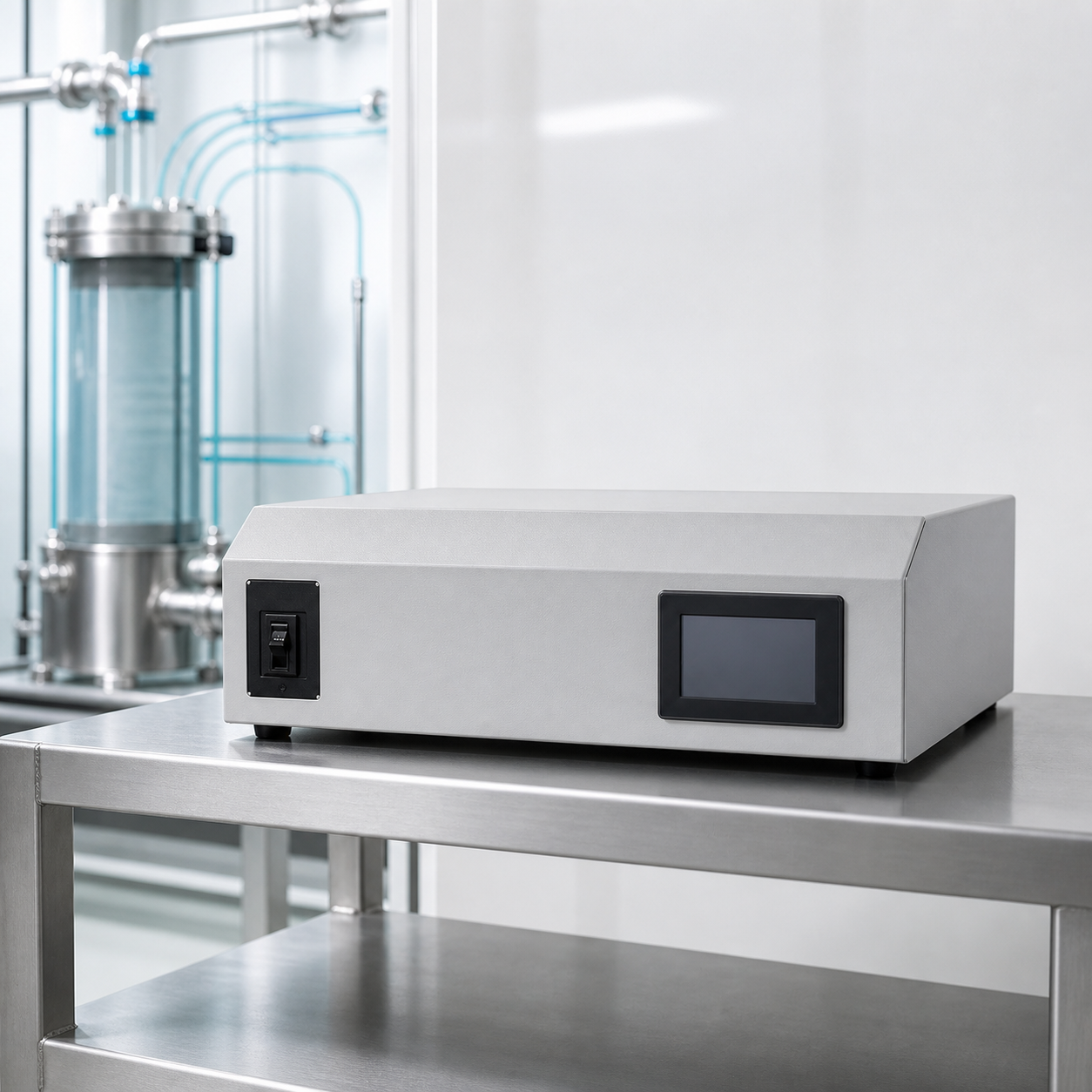
This 200A 18V electrochlorination power supply delivers adjustable DC power to the electrolyzer in an on-site sodium hypochlorite generator. It is intended for compact brine electrolysis systems that need controlled current, a clear local interface, and a horizontal enclosure installed on an equipment frame or flat rack shelf.
The power supply connects the AC source to the DC anode and cathode circuits of the electrolyzer. It can be integrated with the generator control system so that electrical output follows the permitted flow, level, ventilation, and process conditions.
Typical Configuration
| Item | Configuration |
|---|---|
| DC output | 0–18 V, 0–200 A adjustable |
| Rated output power | 3.6 kW |
| AC input | Confirmed against the project supply and current input rules; AC 380 V or 415 V for this rating |
| Regulation mode | Selectable constant-current or constant-voltage operation |
| Cooling | Forced-air cooling |
| Local control | 4.3-inch control interface |
| Installation direction | Horizontal placement on an equipment frame or flat rack shelf |
| Enclosure reference | Approximately 420 × 420 × 170 mm; final construction is confirmed |
| Application | Brine electrolysis and on-site sodium hypochlorite generation |
The final input, enclosure, terminals, cooling arrangement, protection, and control functions are confirmed with the electrolyzer manufacturer or system integrator before production.
Connection to the Electrolyzer
The positive and negative DC outputs connect to the anode and cathode circuits of the electrolysis cell. Cable polarity, terminal material, cable length, and voltage drop must be checked carefully. The rectifier should only be enabled when the required brine flow, cell condition, ventilation, and related process permissives are satisfied.
The power supply is one part of the generator. Brine preparation, water softening where required, electrolyzer construction, gas management, storage, dosing, ventilation, and safety controls remain part of the complete system design.
What the DC Power Supply Controls
DC current is a key operating variable in electrochlorination. Adjustable output allows the system designer to match the electrical load of the cell and control production within the approved operating window. Constant-current operation is often useful when the process needs a controlled electrochemical production rate, while constant-voltage operation can support commissioning and specific control strategies.
Actual sodium hypochlorite concentration and available chlorine production depend on salt concentration, water quality, temperature, electrode condition, current efficiency, flow, cell design, residence time, and downstream handling. The rectifier does not by itself guarantee a production rate or disinfectant concentration.
Sizing Reference
Selection should begin with the required available-chlorine production and the electrolyzer manufacturer’s current and voltage data. Cell quantity and electrical connection determine the voltage range, while production duty and cell area influence the required current.
Please provide:
- Target available-chlorine output or sodium hypochlorite production rate
- Electrolyzer cell model, quantity, and series/parallel connection
- Required cell current and normal operating voltage
- Brine concentration, temperature range, and expected duty cycle
- Available AC supply at the installation
- Floor frame, equipment rack, or shelf placement requirements
- Cable length and DC terminal preference
- Required interlocks, analog commands, alarms, or communication protocol
Control and Integration Options
Depending on the system design, available options can include local touchscreen control, remote enable, current or voltage commands, run and alarm feedback, and industrial communication. The rectifier can also be configured to coordinate with process permissives supplied by the generator controller.
Polarity reversal is not assumed as a standard function. It should only be selected when it is compatible with the electrolyzer design and operating method.
Request a Project Configuration
Send the electrolyzer electrical data, required production duty, AC supply, installation space, ambient conditions, and control-interface list. We will confirm a suitable DC range, input arrangement, enclosure, cooling method, terminals, protection, and integration plan for the sodium hypochlorite generator.