
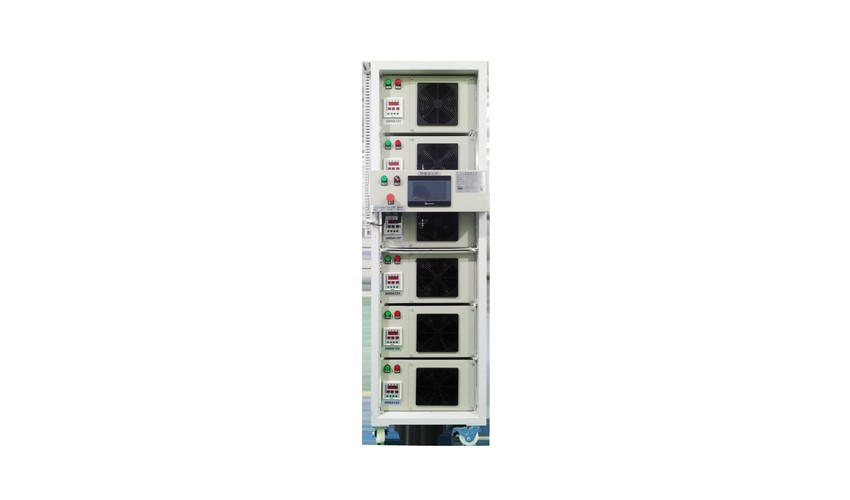
The production of sodium hypochlorite (NaOCl) via on-site electrochemical generation has become the gold standard for municipal water treatment, cooling tower sanitation, and industrial disinfection. At the heart of these systems lies the DC power supply—a critical component that determines not only the efficiency of the chlorine evolution process but also the overall uptime and safety of the installation. For high-capacity systems, a 2000A 48V configuration represents a significant power density that demands specialized engineering, particularly regarding corrosion resistance and advanced thermal management.
The Critical Intersection of Chemistry and Power
Electrochemical generation relies on the electrolysis of a brine solution (NaCl). When high-current DC power is passed through an electrolytic cell, chloride ions are oxidized at the anode to produce chlorine gas, which subsequently reacts with the sodium hydroxide formed at the cathode to produce sodium hypochlorite. This process is inherently energy-intensive and highly sensitive to power fluctuations.
In a 2000A 48V architecture, the power supply must maintain extreme precision. Even minor ripples in the output current can lead to suboptimal electrolytic kinetics, resulting in lower active chlorine concentrations and increased secondary byproduct formation. Furthermore, the 48V threshold is significant; it is high enough to drive efficient cell stacks yet requires robust insulation and safety protocols to manage potential arc flashes and leakage currents in damp, corrosive environments.
Corrosion Resistance: The Primary Design Challenge
Sodium hypochlorite production environments are notoriously harsh. The presence of chlorine gas, moisture, and salt-laden air creates an atmosphere that aggressively attacks standard electronic components. Failure to design for this environment results in rapid oxidation of contactors, circuit boards, and connectors.
To achieve industrial-grade reliability, the 2000A 48V power supply must utilize NEMA 4X or IP65/66-rated enclosures. However, the enclosure is only the first line of defense. Internal components require specialized coatings: conformal coating of PCBs is non-negotiable to prevent electrochemical migration caused by conductive dust or saline humidity. Furthermore, power busbars—which carry the high 2000A current—should be silver or tin-plated and encapsulated where possible to prevent the formation of insulating corrosion layers that would increase resistance and lead to localized heating.
Advanced Heat Management: The Water-Cooled Advantage
At 96kW of output (2000A x 48V), heat dissipation is the most significant limiting factor for system longevity. While air-cooled units are common in smaller applications, the footprint and maintenance overhead of air-cooled systems at this amperage are prohibitive. Air-cooled units require massive heat sinks and large volumes of filtered air, which introduces the risk of contaminated air circulating over sensitive electronics.
Water-cooled power supplies offer a superior alternative. By utilizing a closed-loop deionized water cooling system, the heat generated by the semiconductor junctions (IGBTs/Thyristors) and the output transformer is rejected directly into the plant’s cooling water supply. This methodology provides several distinct advantages:
- Component Longevity: By maintaining a stable, lower junction temperature for the power electronics, the MTBF (Mean Time Between Failure) increases exponentially according to the Arrhenius law of chemical kinetics applied to electronic degradation.
- Compact Footprint: Without the need for massive air-flow channels or bulky radiators, the power supply unit can be significantly reduced in size, allowing for high-density modular installation in tight plant environments.
- Environmentally Isolated Electronics: Water-cooled systems permit a completely sealed enclosure. Since no external air is drawn in for cooling, the internal electronics are shielded from the corrosive chlorine-rich atmosphere of the generator room, effectively eliminating the risk of internal corrosion.
Precision Control and Power Quality
In modern industrial applications, the power supply for a sodium hypochlorite generator is no longer a ‘dumb’ rectifier. It is an intelligent interface. A 2000A 48V system must feature advanced feedback loops that monitor the brine conductivity and temperature in real-time.
Digital control platforms now allow for ‘constant current’ operation, which is vital as cell electrodes age and their impedance changes over time. By automatically adjusting the voltage to maintain a steady 2000A output, the system ensures consistent chlorine output regardless of electrode wear. Furthermore, modern supplies incorporate active Power Factor Correction (PFC) and harmonic suppression, ensuring the plant’s electrical grid is not burdened by the non-linear loads created by high-amperage rectification.
Reliability Through Redundancy
For mission-critical municipal water supplies, downtime is not an option. Industry leaders favor power supplies that utilize a modular internal architecture—parallel converter modules that share the 2000A load. If one module experiences a fault, the system can continue to operate in a ‘derated’ state, preventing a complete cessation of chlorine production. This ‘N+1’ redundancy, paired with real-time remote diagnostics, allows maintenance teams to perform hot-swaps of faulty modules without shutting down the primary electrochemical cell array.
Safety Considerations
Operating at 48V and 2000A involves substantial energy density. The power supply must include comprehensive protection features, including:
– Arc fault detection and suppression.
– Ground fault monitoring (crucial in a water-laden, conductive environment).
– Over-temperature sensors on both the cooling fluid and the critical switching components.
– Fast-acting semiconductor fuses specifically rated for high-amperage DC applications.
The Future of Electrochemical Power Supplies
As the industry moves toward greener, more automated operations, the integration of 2000A 48V water-cooled power supplies into Industry 4.0 frameworks is becoming essential. Data logging of voltage, current, temperature, and cooling flow rates allows for predictive maintenance, where the power supply itself signals when cooling channels are scaling or when electrodes are nearing the end of their service life.
In conclusion, the selection of a power supply for a 2000A 48V sodium hypochlorite generator is a strategic decision that transcends simple voltage and amperage matching. It is an investment in the reliability of the entire water treatment facility. By prioritizing a water-cooled design, enforcing stringent corrosion-mitigation protocols, and utilizing intelligent, redundant control systems, operators can ensure decades of efficient, low-maintenance chemical production. The synergy between high-power electronics and robust industrial cooling represents the pinnacle of modern electrochemical infrastructure, providing the clean water safety that modern society relies upon.