
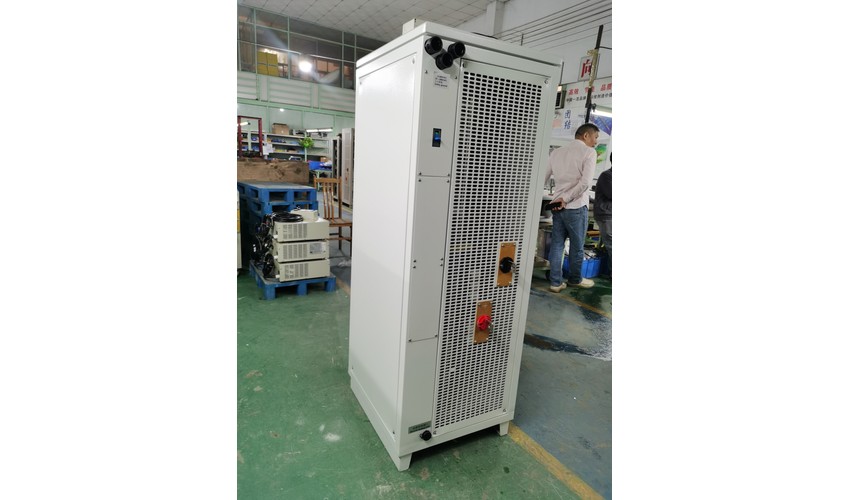
In the modern industrial landscape, wastewater treatment has evolved from a regulatory necessity to a critical pillar of environmental, social, and governance (ESG) compliance. As facilities face increasingly stringent discharge standards, the technology driving electrochemical treatment processes—such as electrocoagulation and electro-oxidation—must advance in tandem. Central to these processes is the industrial power supply, a component often overlooked until its limitations hinder operational productivity. For high-demand applications, the 500A 36V oil-immersed high-frequency switching power supply stands out as the gold standard, balancing immense power density with exceptional environmental resilience.
The Shift to High-Frequency Switching Technology
Traditional wastewater treatment plants historically relied on thyristor-based (SCR) rectifiers. While robust, these systems suffer from significant limitations in efficiency, harmonic distortion, and footprint. The paradigm shift toward high-frequency switching power supplies (HF-SMPS) has fundamentally altered the economics of water treatment.
By operating at frequencies significantly higher than the 50Hz/60Hz grid frequency, high-frequency units utilize smaller magnetic components and transformers. This reduction in physical mass does not sacrifice output quality; rather, it allows for a faster transient response. In a 500A 36V configuration, this translates to extremely precise control over the electrochemical current density. As the conductivity of wastewater fluctuates—a common occurrence in industrial effluents—a high-frequency power supply can adjust its output in milliseconds, maintaining the integrity of the treatment process without the “lag” associated with older transformer-rectifier sets.
The Necessity of Oil-Immersed Design in Harsh Environments
Industrial wastewater facilities are inherently corrosive. Exposure to humidity, acid vapors, and chemical mists can wreak havoc on sensitive power electronics. Standard air-cooled systems, which require intake vents for airflow, are highly susceptible to dust accumulation and chemical degradation of printed circuit boards (PCBs).
An oil-immersed design serves as a total environmental barrier. By submerging the transformer and critical power stages in a sealed, dielectric oil bath, the system achieves two objectives:
- Hermetic Protection: The internal components are completely isolated from the external atmosphere. This eliminates the risk of oxidation and short-circuiting caused by corrosive airborne particles.
- Superior Thermal Management: Oil is an excellent heat conductor. It effectively wicks heat away from the semiconductor components and the transformer windings, transporting it to the cooling surfaces of the tank. This ensures that the 500A output remains stable, even during 24/7 operation in high-ambient-temperature industrial zones.
When combined with high-frequency switching, the oil-immersed design offers a “fit-and-forget” solution that minimizes downtime and maintenance costs—a critical factor for facilities operating under tight budgetary constraints.
Maximizing Energy Efficiency Standards
Energy efficiency is the primary metric for operational cost control. In wastewater treatment, the electrolytic cell is a resistive load that demands high current. Inefficient power conversion manifests as heat loss, which not only drives up electricity bills but also necessitates additional cooling infrastructure, further increasing energy consumption.
Modern 500A 36V high-frequency units boast power conversion efficiencies exceeding 92-95%. This efficiency is achieved through advanced power electronics, such as Insulated Gate Bipolar Transistors (IGBTs) or Silicon Carbide (SiC) MOSFETs, which minimize switching losses. Furthermore, the high power factor characteristic of these units reduces reactive power demand on the facility’s electrical grid, potentially lowering utility penalties associated with poor power factor management.
For an industrial facility running 500A loads, a 5% improvement in efficiency compared to a legacy SCR system can result in thousands of dollars in annual savings. Beyond the balance sheet, this aligns with the global mandate for industrial decarbonization, as reducing energy demand is the most immediate way to lower the carbon footprint of wastewater remediation.
Precision Control and Process Optimization
At the core of electrocoagulation is the dissolution of sacrificial anodes. Precise control of the 36V potential and 500A current is vital to achieving the desired removal rates for heavy metals, fats, oils, grease (FOG), and suspended solids.
High-frequency power supplies integrate sophisticated digital control logic that allows for:
- Constant Current (CC) Mode: Ensuring a steady supply of ions from the electrodes, which is essential for consistent flocculation.
- Programmable Pulse Width Modulation (PWM): Allowing operators to pulse the current, which can help in descaling the electrodes and prolonging their service life.
- Communication Interfaces: Modern units feature Modbus, PROFIBUS, or Ethernet connectivity, enabling real-time monitoring and integration into Distributed Control Systems (DCS) or PLC-based plant automation.
This level of control ensures that the power supply is not merely a source of electricity but an active participant in the chemical engineering process. Operators can fine-tune the treatment parameters to match the effluent load, preventing the waste of energy during periods of low influent concentration.
The Reliability Factor: Minimizing Downtime
In industrial water treatment, downtime is often synonymous with regulatory fines and production halts. The 500A 36V oil-immersed unit is built for longevity. The oil bath provides high dielectric strength, protecting against voltage spikes and surges that might otherwise damage solid-state components. Furthermore, the oil immersion acts as a damping medium for vibrations, protecting the internal magnetic components from mechanical stress in industrial environments where heavy machinery may cause constant low-frequency tremors.
Moreover, these systems often include redundant protection features, such as over-temperature sensing, phase loss protection, and output short-circuit protection. These safeguards prevent cascading failures, ensuring that if an anomaly occurs, the power supply enters a safe shutdown state rather than undergoing catastrophic damage.
Future-Proofing Industrial Water Treatment
As industrial processes become more complex, the effluents they produce are becoming harder to treat. Emerging pollutants, such as microplastics and complex pharmaceuticals, require increasingly robust treatment technologies. The high-frequency power supply provides the agility needed to evolve these processes. Whether a facility upgrades to newer, more efficient electrode materials or adopts advanced oxidation processes (AOPs) that require higher voltage transients, the flexibility of the high-frequency switching architecture ensures the power system remains relevant for years to come.
Conclusion
Investing in a 500A 36V oil-immersed high-frequency power supply is a strategic decision that transcends simple equipment procurement. It is a commitment to operational excellence, energy efficiency, and environmental stewardship. By leveraging the benefits of high-frequency switching—namely, efficiency and precise control—and coupling them with the ruggedness of oil-immersed engineering, industrial facilities can significantly optimize their wastewater treatment operations.
In a sector where reliability and regulatory compliance are non-negotiable, these advanced power systems provide the foundation for sustainable industrial growth. For companies looking to reduce their operational expenditure while meeting the rigorous demands of modern environmental standards, the transition to high-frequency, oil-immersed power technology is the clear, logical, and profitable path forward.