
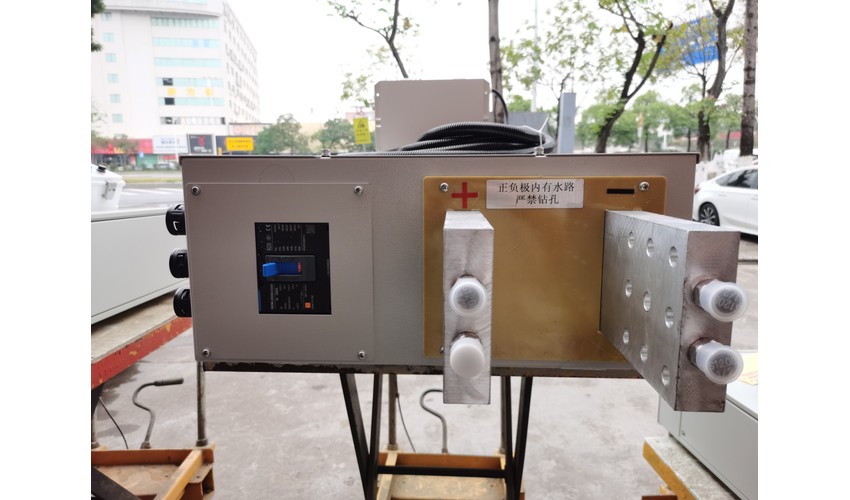
In the landscape of industrial wastewater treatment and chemical synthesis, the Electro-Fenton process has emerged as a cornerstone technology for the degradation of recalcitrant organic pollutants. As electrochemical advanced oxidation processes (EAOPs) scale from laboratory pilot projects to massive industrial installations, the demand for power conversion equipment that can withstand volatile, corrosive, and high-temperature environments has reached a critical juncture. GAOHUI, a global leader in high-current power electronics, has answered this challenge with its flagship 3000A 150V oil-immersed power supply, a unit specifically engineered to bridge the gap between volatile chemical reactions and stable, long-term power delivery.
The Engineering Challenge: Precision Under Pressure
The Electro-Fenton process relies on the continuous generation of hydroxyl radicals (•OH) via the in-situ production of hydrogen peroxide and the regeneration of ferrous ions. This process is inherently energy-intensive, requiring high current densities to drive the catalytic cycles efficiently. A 3000A 150V configuration provides a massive 450kW of power, which, if not managed with absolute precision, can lead to severe electrolytic fluctuations, electrode degradation, and system failures.
In typical industrial settings—often characterized by ambient chemical vapors, high humidity, and airborne particulates—standard air-cooled power supplies fall short. The ingress of conductive dust or corrosive acid mist leads to short circuits and component degradation. GAOHUI’s design philosophy for the 3000A 150V unit centers on total environmental isolation, utilizing oil-immersion to transform the power supply into an impenetrable fortress.
Corrosion Resistance: The Oil-Immersed Advantage
Corrosion is the silent killer of industrial power electronics. In facilities utilizing Electro-Fenton treatments, the atmosphere is frequently saturated with acidic fumes and electrolysis byproducts that attack copper busbars, circuit boards, and sensitive control interfaces.
GAOHUI’s oil-immersed architecture provides a twofold solution to this threat. First, by submerging the transformer windings, high-frequency inductors, and power modules in a high-grade, dielectric insulating oil, the company completely eliminates the possibility of atmospheric gas or moisture contact with critical components. Unlike air-cooled systems that require forced ventilation—which essentially ‘sucks’ corrosive air directly onto the electronics—the GAOHUI system is hermetically sealed.
Second, the oil acts as an inert chemical buffer. Should a catastrophic failure occur, the oil inhibits the propagation of secondary chemical reactions, ensuring that the integrity of the unit remains intact. This design extends the operational lifespan of the power supply from the typical 3–5 years seen in air-cooled units to over a decade of continuous, high-load duty cycles.
Advanced Heat Management: Beyond Forced Air
Efficiency in an Electro-Fenton system is directly tied to the stability of the power supply’s output voltage. Heat, however, is the enemy of stability. Semiconductors used in rectification and switching generate intense heat at 3000A; if the temperature drifts, the switching frequency stability suffers, potentially leading to ‘ripple’ in the output, which negatively impacts radical generation efficiency.
GAOHUI engineers have implemented an advanced thermodynamic management system within the 3000A 150V unit. The dielectric oil acts as a superior heat transfer medium compared to air, efficiently wicking thermal energy away from the power modules and into the tank walls. This is further supported by an external, closed-loop heat exchanger system (water-to-oil or air-to-oil). By decoupling the internal heat generation from the external environmental conditions, GAOHUI ensures that the internal components operate at a constant, optimized temperature regardless of whether the ambient factory temperature is 10°C or 50°C. This thermal equilibrium is vital for maintaining the precise current densities required to catalyze the Fenton reaction without wasting power on energy-intensive cooling fans that are prone to mechanical failure.
Reliability Through Robust Design
Reliability is not merely a feature; it is a requirement for continuous wastewater processing plants. A 3000A 150V power supply often serves as the ‘heart’ of the entire facility; if it stops, the biological and chemical processes downstream can suffer catastrophic setbacks.
GAOHUI incorporates high-density, multi-stage filtration in their rectification stage to ensure that the output is free of transients that could damage the electrodes or lead to inefficient radical production. Furthermore, the unit includes comprehensive safety protocols:
– Redundant Thermal Monitoring: Sensors embedded deep within the transformer windings monitor temperature at the source, triggering auto-derating or shutdown if limits are exceeded.
– Arc-Fault Protection: Given the high current (3000A), any potential for arcing at the contact points is mitigated by specialized potting and busbar geometry.
– Digital Feedback Loop: The unit integrates seamlessly with PLC/SCADA systems, allowing operators to monitor real-time output and voltage consistency, ensuring that the Electro-Fenton process remains at its kinetic peak.
The Economic Argument for GAOHUI
While the initial investment for a 3000A 150V oil-immersed unit is higher than that of an air-cooled alternative, the Total Cost of Ownership (TCO) tells a different story. In the industrial wastewater sector, downtime costs can reach thousands of dollars per hour. The GAOHUI design eliminates the need for expensive air filtration systems, periodic cleaning of clogged heatsinks, and the frequent replacement of electrolytic capacitors—which often fail in air-cooled environments due to heat-induced electrolyte dry-out.
By choosing GAOHUI, operators are not just buying a power supply; they are buying a guarantee of uptime. The rugged nature of the oil-immersed tank means that the hardware is future-proofed against the environmental degradation that typically forces plant managers to retire power systems early.
Conclusion
The implementation of Electro-Fenton technology is a significant step toward cleaner, more sustainable industrial practices. However, the efficacy of these systems is limited by the quality of their power delivery. With the 3000A 150V oil-immersed power supply, GAOHUI has set the gold standard for industrial electrochemical hardware. By prioritizing total chemical isolation, superior dielectric cooling, and rigorous reliability protocols, GAOHUI empowers chemical engineers and plant operators to focus on what matters most: efficient, compliant, and cost-effective pollutant degradation. As the industry moves toward higher capacities and more stringent environmental regulations, having a power partner as resilient as the GAOHUI oil-immersed system is no longer an advantage—it is an operational necessity.