
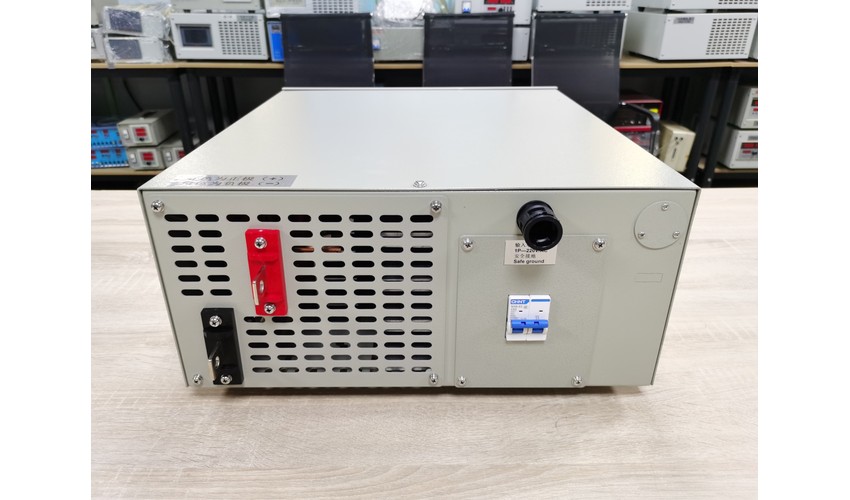
In the modern industrial landscape, the stringent requirement for effective on-site wastewater treatment has catapulted the Electro-Fenton (EF) process to the forefront of electrochemical engineering. As an advanced oxidation process (AOP), Electro-Fenton relies on the continuous in-situ generation of hydrogen peroxide (H2O2) and hydroxyl radicals (·OH) to mineralize recalcitrant organic pollutants. At the heart of this process lies the power delivery system—the Electro-Fenton power supply. Specifically, in medium-to-large scale industrial applications, the 500A 12V air-cooled configuration represents the ‘sweet spot’ for balance, efficiency, and scalability.
The Critical Role of the Electro-Fenton Power Supply
The Electro-Fenton process is inherently demanding. Unlike steady-state electroplating, EF processes are dynamic. The electrical load fluctuates based on the concentration of contaminants, the pH of the electrolyte, and the progressive degradation of electrodes (typically Carbon-PTFE or Boron-Doped Diamond). A 500A 12V power supply must provide high-precision current regulation, as the rate of radical generation is directly proportional to the current density applied to the cathode.
If the power supply lacks the stability to maintain a constant current under changing electrochemical impedance, the process efficiency drops, leading to excessive energy consumption and incomplete mineralization of pollutants. Reliability is not merely a feature; it is the cornerstone of regulatory compliance.
Designing for Harsh Industrial Environments: Corrosion Resistance
Electro-Fenton systems operate in environments laden with aggressive chemical fumes—acid mists, volatile organic compounds, and high humidity are the norm. Standard power electronics are typically doomed to failure in such settings unless specific environmental hardening is employed.
For a 500A 12V unit, the internal architecture must prioritize the following:
- Conformal Coating: All printed circuit boards (PCBs) must be treated with a high-dielectric conformal coating (usually silicone or acrylic-based) to prevent salt bridges and dendritic growth caused by moisture and condensation.
- Busbar Protection: Copper busbars, which carry the high 500A current, are susceptible to oxidation. Industry-standard units utilize nickel or silver plating on all contact points to minimize contact resistance, which would otherwise lead to localized heating—a common failure point in high-current systems.
- Enclosure Integrity: The chassis must feature an IP54-rated enclosure design that utilizes a dedicated airflow path. This path must separate the sensitive control electronics from the intake air that may carry corrosive contaminants, effectively creating a ‘clean zone’ within the power supply housing.
The Challenge of Thermal Management in Air-Cooled Systems
While liquid cooling is often marketed for high-current applications, air-cooled 500A 12V units are significantly preferred for their ease of maintenance, lower total cost of ownership, and immunity to coolant leaks. However, the reliance on forced-air cooling requires sophisticated engineering.
Thermal management in an Electro-Fenton power supply is primarily focused on the power semiconductors—the Insulated Gate Bipolar Transistors (IGBTs) or MOSFET modules. At 500A, even a 0.5V voltage drop across the switching devices results in 250W of dissipated heat per switch. Over a multi-module array, this requires a massive thermal budget.
Effective heat management is achieved through three strategies:
- Optimized Heatsink Geometry: Using extruded aluminum profiles with high fin-density that are oriented to take advantage of natural convection, supplemented by high-static-pressure industrial-grade fans. These fans should feature variable speed controls based on internal thermistors, ensuring the supply operates at optimal efficiency without constant full-load noise.
- Component Derating: Professional-grade power supplies adhere to rigorous derating standards. A 500A supply should be built with internal components rated for 600A-700A. By running the electronics at 70-80% of their maximum capacity, the heat signature is significantly lowered, exponentially increasing the Mean Time Between Failures (MTBF).
- Directed Airflow Design: The internal layout must utilize internal baffles to ensure that the air drawn from the intake is directed specifically over the magnetics and the power stage. By eliminating ‘dead spots’ where air can stagnate, the design prevents thermal throttling—a scenario where the power supply would otherwise drop output current to protect itself, thereby compromising the wastewater treatment process.
Operational Reliability and Control Systems
For a 500A 12V Electro-Fenton supply, the control architecture must be robust enough to handle the non-linear behavior of an electrochemical cell. Modern units incorporate a digital signal processor (DSP) to implement real-time current limiting and soft-start capabilities.
When electrodes are first energized, the electrochemical cell can experience an ‘inrush’ impedance characteristic. The power supply must be capable of ramping up current precisely, preventing the damage that sudden spikes cause to the cathode surface. Furthermore, the inclusion of RS485/Modbus or Ethernet/IP communication protocols allows for seamless integration into a plant’s Supervisory Control and Data Acquisition (SCADA) system. This integration allows plant operators to monitor the health of the power supply and the electrochemical process in real-time, receiving alerts for voltage ripple or fan failure before a total system shutdown occurs.
Maximizing Efficiency: The 12V Advantage
Why choose a 12V output? In EF applications, the voltage requirement is generally lower than in traditional electro-winning. 12V provides the necessary headroom to overcome electrolyte resistance without unnecessary power dissipation across the busbars. When the supply is sized correctly to the process, the efficiency of the conversion stage (typically using a high-frequency switch-mode design) can exceed 92%. This efficiency is critical; a 1% gain in efficiency over a 500A system results in massive energy savings over a 24/7 operating cycle, drastically reducing the operational carbon footprint of the wastewater treatment plant.
Conclusion: The Investment in Durability
Selecting a 500A 12V Electro-Fenton power supply is an investment in the longevity of an industrial facility’s waste management infrastructure. While entry-level power supplies may offer lower initial costs, the long-term expenditure related to downtime, corrosion damage, and energy waste often outweighs the savings.
By focusing on robust thermal design, stringent environmental sealing, and advanced current control, engineers can deploy power supplies that act as the steady, reliable backbone of the Electro-Fenton process. In the high-stakes world of industrial water treatment, where environmental compliance and process uptime are non-negotiable, the reliability of the power source is the singular factor that differentiates a high-functioning facility from an operational liability. As technology progresses, the transition toward air-cooled, intelligent power electronics continues to define the standard for electrochemical excellence.