
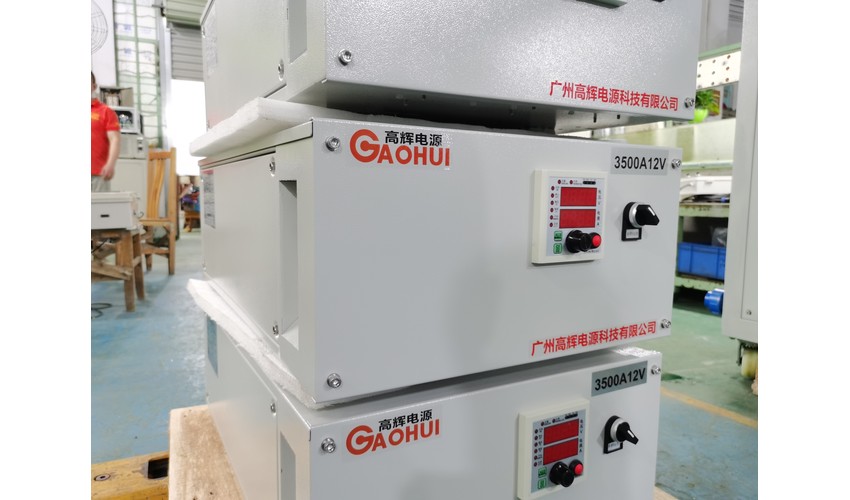
In the modern industrial landscape, where precision meets mass-scale throughput, the backbone of operational reliability is the power supply unit (PSU). Specifically, for scale collection systems—which demand rigorous consistency in load cell excitation and high-current processing—the transition from traditional linear power supplies to high-frequency switching-mode power supplies (SMPS) has revolutionized performance. The 500A 24V air-cooled power supply represents a critical nexus of density, efficiency, and thermal management.
The Architecture of High-Frequency Switching
At the core of a modern 500A 24V industrial power supply lies the high-frequency switching topology. Unlike legacy transformer-based designs that operate at the grid frequency (50/60 Hz), modern systems employ pulse-width modulation (PWM) switching frequencies typically ranging from 50 kHz to 200 kHz.
By elevating the switching frequency, engineers can significantly reduce the physical size of the inductive and capacitive components—transformers, chokes, and filter capacitors. For a 500A unit, this is transformative. A transformer designed for 60 Hz would be prohibitively heavy and inefficient, whereas a high-frequency ferrite-core transformer allows for compact power density, enabling the 500A current output to be achieved within a standard rack-mount or industrial chassis footprint.
This high-frequency operation is not merely about size; it is about responsiveness. Scale collection systems often face transient load fluctuations as sensors stabilize or materials are processed. The rapid switching speed allows the control loop to adjust output voltage in micro-seconds, ensuring that the 24V rail remains rock-steady regardless of load variations. This precision is non-negotiable when dealing with the high-resolution data streams required in modern weigh-scale instrumentation.
Efficiency Standards and Thermal Dynamics
Efficiency is the primary metric by which modern power electronics are judged. In a 500A 24V system, the total output power is 12,000 Watts (12 kW). If a system operates at 85% efficiency, it must dissipate 1.8 kW of energy as heat. If that efficiency is pushed to 95%—a target for leading-edge industrial supplies—the heat loss drops to 600 Watts.
This 1.2 kW difference is profound. It dictates the requirements for air cooling and the overall lifespan of the internal semiconductors. High-frequency SMPS designs utilize Silicon Carbide (SiC) and Gallium Nitride (GaN) components to minimize conduction and switching losses. These wide-bandgap semiconductors allow for tighter switching intervals with minimal thermal overhead.
For 500A units, air cooling remains the standard due to its simplicity, lower maintenance requirements, and ease of deployment compared to liquid-cooled counterparts. However, the design of an air-cooled system at this amperage requires sophisticated computational fluid dynamics (CFD) modeling. The chassis must be engineered to create laminar airflow across the heat sinks, preventing thermal bottlenecks at the high-current busbars. By utilizing intelligent, variable-speed fan controllers that tie into the thermal monitoring of the IGBTs (Insulated Gate Bipolar Transistors), manufacturers can optimize power draw, further enhancing the system’s overall energy efficiency footprint.
Managing High-Current Density and Busbar Integrity
Delivering 500A requires meticulous attention to the physical path of the current. Resistive losses (I²R losses) are the enemy of efficiency. In a 500A 24V system, even a fraction of a milliohm of resistance across a connection point results in significant voltage drop and unwanted localized heating.
Engineers utilize heavy-gauge, gold-plated or silver-plated copper busbars to facilitate current flow. The internal architecture of the 500A unit is designed to minimize the path length between the rectification stage and the output terminals. Furthermore, the skin effect—the tendency of AC to flow near the surface of a conductor at high frequencies—is mitigated by using laminated busbars and high-frequency-optimized capacitors that stabilize the output ripple. This ripple current management is crucial for scale collection; excessive electrical noise can induce interference in sensitive analog-to-digital converters (ADCs), leading to “noisy” weight readings and inaccurate data.
Reliability and Regulatory Compliance
In industrial environments, the 500A 24V power supply often operates 24/7. Compliance with international standards, such as IEC 60950 for safety and EN 61000 for electromagnetic compatibility (EMC), is the baseline requirement.
However, professional-grade systems go beyond compliance. They incorporate proactive monitoring, such as N+1 redundancy features, allowing multiple 500A modules to be paralleled. This configuration ensures that if one supply encounters a fault, the scale collection process continues uninterrupted—a critical feature for automated industrial weighing and sorting lines. Furthermore, active Power Factor Correction (PFC) is integrated into these units, ensuring the system operates with a power factor close to 0.99, reducing harmonic distortion on the facility’s power grid and lowering utility energy costs.
The Future: Digital Control and Predictive Maintenance
The next frontier for the 500A 24V air-cooled PSU is the integration of digital telemetry. By embedding microcontrollers that track output voltage, current, internal temperature, and fan performance, these power supplies move from being passive components to active network nodes.
Through protocols like Modbus TCP, CANopen, or EtherCAT, facility managers can gain real-time visibility into the health of their power infrastructure. Predictive maintenance algorithms can analyze the aging of electrolytic capacitors or the performance degradation of cooling fans, signaling the need for intervention before a failure occurs. This is the hallmark of Industry 4.0—where the power supply is no longer a “black box” but an intelligent system that ensures the reliability and accuracy of the entire production chain.
Conclusion
Choosing a 500A 24V power supply for scale collection applications requires more than just meeting the basic electrical specifications. It necessitates a deep commitment to high-frequency switching efficiency, robust thermal management, and adherence to global energy efficiency standards. As the demand for higher precision and greater throughput continues to rise, the marriage of advanced power electronics and intelligent monitoring will remain the defining characteristic of superior industrial power solutions.
By investing in high-efficiency, air-cooled 500A systems, operators not only lower their carbon footprint and electricity expenditure but also secure the fundamental stability of their measurement and processing systems. In the high-stakes world of industrial weight collection, the power supply is the silent partner of success—performing at the limits of physics to ensure that every gram counts.