
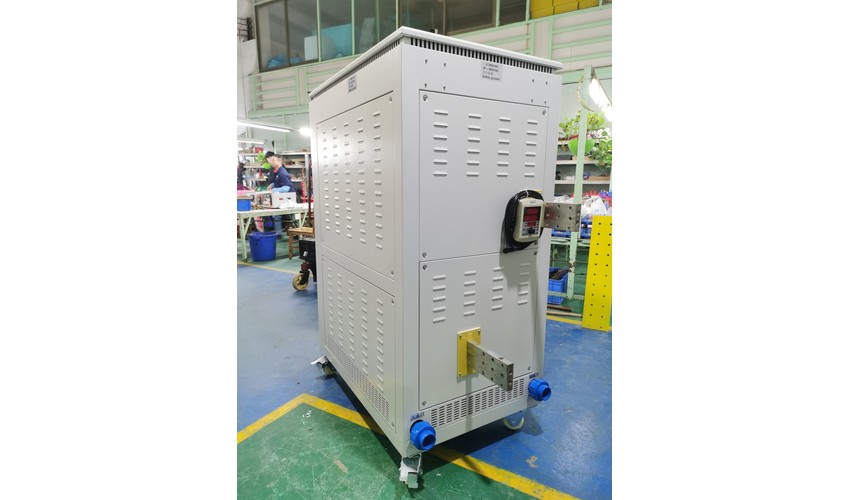
In the modern industrial landscape, water treatment processes—ranging from advanced electro-coagulation and electro-oxidation to heavy metal recovery—have become increasingly reliant on high-current, precision-controlled direct current (DC) power. As industrial standards shift toward carbon neutrality and operational cost optimization, the infrastructure providing this power has come under intense scrutiny. At the forefront of this evolution is the GAOHUI 12000A 100V Water-Cooled Rectifier, a piece of engineering designed to meet the rigorous demands of high-capacity electrochemical water treatment while setting new benchmarks for energy efficiency through high-frequency switching technology.
The Shift to High-Frequency Switching Technology
Traditional industrial rectifiers, historically dominated by silicon-controlled rectifiers (SCR) or thyristor-based systems, have long been criticized for their significant energy losses, massive physical footprint, and poor power factor. GAOHUI has disrupted this paradigm by integrating state-of-the-art Insulated Gate Bipolar Transistors (IGBT) and high-frequency pulse-width modulation (PWM) switching technology into its 12000A 100V systems.
High-frequency switching allows the GAOHUI rectifier to operate at frequencies significantly higher than standard grid-line frequencies. This transition offers three primary benefits: reduced harmonic distortion, smaller transformer size, and instantaneous response to process load changes. By switching at frequencies in the kilohertz range, the power conversion process minimizes the time the components spend in the resistive phase, which significantly reduces internal heat generation. For water treatment facilities handling volatile contaminants, this high-speed regulation ensures that current density remains constant, even if the conductivity of the influent water fluctuates.
Thermal Management: The Necessity of Water Cooling
Operating at a colossal 12000A output requires exceptional thermal dissipation. Heat is the primary enemy of power electronics; excessive temperatures lead to component fatigue, semiconductor degradation, and eventually, unplanned downtime. GAOHUI’s 100V 12000A water-cooled design represents the gold standard in thermal efficiency.
Unlike traditional air-cooled units that require massive heat sinks and industrial-grade fan arrays—which often ingest corrosive, humid, or dusty air from water treatment plant environments—the GAOHUI water-cooled architecture provides a closed-loop internal thermal management system. By utilizing a high-efficiency heat exchanger, the unit effectively transfers internal heat into the facility’s cooling water loop. This approach not only ensures that the internal components remain at an optimal operating temperature, extending the MTBF (Mean Time Between Failures) of the unit, but it also allows for a compact design, enabling GAOHUI systems to fit into space-constrained facility layouts without the need for massive airflow clearances.
Achieving Energy Efficiency Standards
As global regulatory bodies enforce stricter ESG (Environmental, Social, and Governance) standards, power conversion efficiency has moved from a secondary consideration to a primary KPI for facility managers. Older thyristor rectifiers typically achieve efficiencies in the 85-90% range. The GAOHUI 12000A system, utilizing advanced MOSFET/IGBT switching and low-loss magnetic components, consistently achieves energy conversion efficiencies exceeding 95-97%.
Over a 24/7 operating cycle, the 5-10% difference in efficiency represents a massive reduction in operational expenditure (OPEX). For a facility running a 1.2MW (12000A x 100V) load, an improvement of just 5% efficiency translates to saving 60kW per hour. When extrapolated over an annual cycle, this results in hundreds of megawatt-hours saved, significantly lowering the carbon footprint of the water treatment plant. GAOHUI’s control algorithms further optimize this by employing “soft-switching” techniques, which minimize the electrical stress on components during the turn-on and turn-off phases of the switching cycle, further curbing energy waste.
Precision Control and Advanced Connectivity
In electrochemical water treatment, the purity and consistency of the DC signal are critical to the chemical reactions involved—such as the formation of hydroxyl radicals for wastewater degradation. Ripples in the output current can lead to inconsistent chemical dosing and electrode passivation. The GAOHUI 12000A rectifier features a high-precision digital control architecture that maintains a current ripple factor of less than 1%, ensuring that the electrochemical cells receive a “clean” DC signal.
Beyond basic voltage and current regulation, GAOHUI systems are built for the Industry 4.0 ecosystem. The integrated control interface supports standard fieldbus protocols like Modbus, Profibus, or PROFINET. This connectivity allows the rectifier to communicate in real-time with a facility’s PLC (Programmable Logic Controller) or SCADA system. Operators can perform remote diagnostic monitoring, adjust output parameters based on water quality sensors, and receive automated maintenance alerts. This level of digital integration is vital for modern plants that aim to automate their water treatment cycles to minimize human error and optimize chemical consumption.
Structural Reliability in Harsh Environments
Water treatment facilities are inherently corrosive environments. Humidity, moisture, and chemical vapors can wreak havoc on sensitive electronics. GAOHUI builds its rectifiers with a modular, sealed-cabinet design that prioritizes isolation. Internal power modules are housed in robust, protective enclosures, while the modular design allows for rapid field replacement should a specific sub-assembly require attention. This modularity reduces maintenance lead times from days to hours, ensuring that the critical water treatment infrastructure remains operational.
Furthermore, the 12000A 100V rating allows for significant scaling. For massive municipal or large-scale industrial treatment plants, GAOHUI rectifiers can be operated in parallel, with intelligent load-sharing algorithms that ensure even distribution of current across multiple units. This master-slave configuration provides redundancy; if one unit requires maintenance, the others can adjust to maintain the process output, ensuring that the facility never stops processing water.
Conclusion: The Future of Electrochemical Power
The integration of GAOHUI’s 12000A 100V water-cooled rectifier represents more than just a power supply upgrade; it is a strategic investment in process stability and operational economy. By combining high-frequency switching technology with superior thermal management, GAOHUI addresses the fundamental challenges of high-current DC application in industrial water treatment.
As the industry continues to move toward smarter, cleaner, and more efficient water reclamation solutions, GAOHUI remains committed to advancing the hardware that powers these vital processes. For operators facing the dual pressure of increasing wastewater complexity and tightening energy budgets, the GAOHUI high-frequency switching rectifier offers the precision, efficiency, and reliability necessary to maintain a competitive and sustainable operation. Investing in such advanced hardware is no longer merely an option; it is a fundamental requirement for the future of industrial water treatment.