
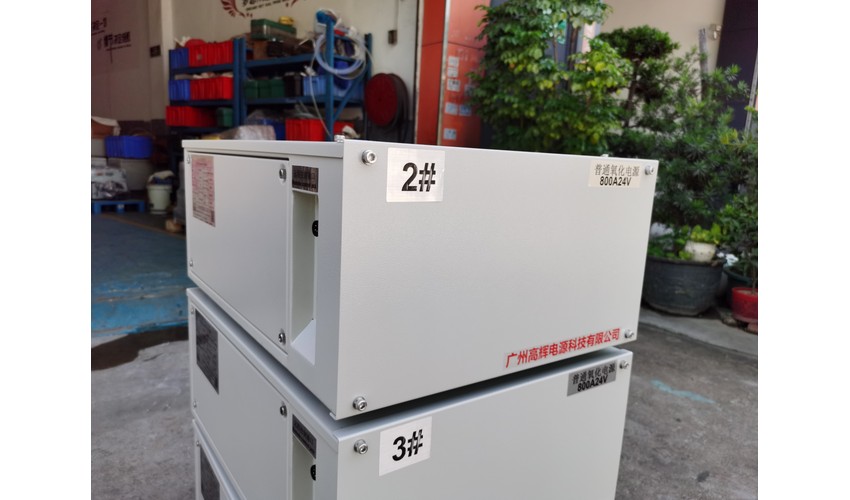
Sodium hypochlorite (NaOCl) is a cornerstone disinfectant in municipal water treatment, wastewater processing, and industrial sanitation. Its on-site generation offers significant safety and logistical advantages over bulk chemical delivery. At the heart of every efficient NaOCl generation system lies a robust and reliable power supply, a component often overlooked but critical to consistent performance. This article delves into the specialized requirements and superior benefits of a 2000A 36V oil-immersed power supply, focusing on its unparalleled reliability, inherent corrosion resistance, and sophisticated heat management capabilities—factors that ensure continuous, high-performance operation in demanding industrial environments.
On-site NaOCl generation leverages electro-chlorination, an electrochemical process where a dilute brine solution (sodium chloride and water) is passed through an electrolytic cell. With the application of direct current, the salt solution is converted into a hypochlorite solution and hydrogen gas. This method eliminates the need for transporting and storing hazardous chlorine gas or concentrated liquid bleach, significantly enhancing operational safety and reducing chemical procurement complexities. For this critical conversion to occur effectively and consistently, a steady, precisely regulated DC power supply is indispensable. The quality and stability of this electrical input directly influence the efficiency, purity, and yield of the generated hypochlorite, making the power supply a non-negotiable component for successful disinfection.
The specifications 2000A and 36V are indicative of a power supply designed for large-scale industrial applications. A 2000-ampere output signifies its capacity to drive multiple electrolytic cells or very large single cells, ensuring high volumes of NaOCl production. The 36-volt output is optimized for the typical voltage drop across an array of electrolytic cells, balancing efficiency with the necessary potential difference for the electrochemical reaction. However, the most distinguishing feature, and perhaps the most vital for longevity and performance, is its “oil-immersed” design. Unlike conventional air-cooled or forced-air systems, this design encapsulates the transformer, rectifier, and other critical components within a dielectric fluid, typically mineral oil. This strategic choice underpins the exceptional characteristics explored below.
In applications where public health and industrial processes depend on continuous disinfection, power supply reliability is paramount. The oil-immersed design inherently boosts reliability by providing a hermetically sealed environment for sensitive internal components. This protective barrier shields against common industrial threats such as dust, moisture, and airborne contaminants that can degrade insulation, corrode connections, and lead to short circuits in air-cooled systems. The consistent thermal environment afforded by the oil also reduces thermal cycling stress on components, a major factor in premature failure. Furthermore, the robust construction often associated with oil-immersed units, including heavy-duty casings and quality internal wiring, ensures resilience against vibrations and minor physical impacts common in industrial settings. This commitment to continuous uptime translates directly into operational stability and reduced maintenance costs.
Sodium hypochlorite generation facilities are intrinsically corrosive environments. The presence of brine, chlorine gas (even in trace amounts), and elevated humidity levels can rapidly degrade unprotected electronic components and metallic surfaces. This is where the oil-immersed power supply truly excels. By immersing the active components in dielectric oil, they are completely isolated from the corrosive atmosphere. The oil acts as an impenetrable shield, preventing direct contact with corrosive gases and moisture. While the external casing and connection points still require robust corrosion-resistant materials (e.g., marine-grade stainless steel or specialized powder coatings), the vital internal workings are supremely protected. This comprehensive approach to corrosion resistance significantly extends the lifespan of the power supply, preventing costly failures and ensuring consistent performance even in the most aggressive industrial settings.
Generating 2000 amps of DC power invariably produces substantial heat losses within the power supply’s transformer and rectifier stages. Inadequately managed heat is the nemesis of electronic components, leading to reduced efficiency, accelerated aging, and ultimately, catastrophic failure. The oil-immersed design offers a superior solution for heat dissipation compared to air-cooling. Dielectric oil possesses excellent thermal conductivity and a high specific heat capacity, making it a highly effective medium for absorbing and transferring heat away from the core components. The heat generated within the windings and semiconductor devices is efficiently transferred to the surrounding oil, which then circulates (naturally or via pumps) to external cooling fins or radiators. These external surfaces dissipate the heat to the ambient air or a secondary cooling loop (e.g., water), maintaining stable internal temperatures. This precise and efficient thermal management ensures that the power supply operates within its optimal temperature range, maximizing efficiency, extending component life, and guaranteeing stable output current and voltage for the NaOCl generation process.
The 2000A 36V oil-immersed power supply is far more than just a rectifier; it is a meticulously engineered solution designed to withstand the rigors of demanding industrial applications, particularly in sodium hypochlorite generation. Its inherent design advantages—superior reliability through environmental protection, unparalleled corrosion resistance afforded by oil immersion, and highly efficient heat management capabilities—collectively ensure uninterrupted operation, extended service life, and consistent output. For industries where continuous disinfection is critical, investing in such a robust and resilient power supply is not merely a choice for performance but a fundamental commitment to operational safety, cost-effectiveness, and environmental compliance. It stands as a testament to industrial design where specialized engineering addresses specific challenges, delivering power with purity and unwavering dependability.