
The Evolution of Electrochemical Water Treatment in 2026
As industrial regulations tighten and the global mandate for circular water economies intensifies, electrochemical water treatment (EWT) has moved from an experimental niche to a baseline requirement for sustainable manufacturing. At the heart of these high-capacity systems lies the power electronics architecture. For large-scale industrial effluent treatment, mining operations, and municipal desalination, the 3000A 100V pulsed DC power supply has emerged as the ‘gold standard’ configuration. This guide examines the technical imperatives, fiscal advantages, and market trends defining the procurement landscape in 2026.
Why Pulsed DC? The Physics of Efficiency
Standard continuous DC power often suffers from ‘passivation’—a phenomenon where insulating layers form on electrode surfaces, increasing resistance and energy waste. Pulsed DC power supplies combat this by interrupting the current flow at high frequencies.
In a 3000A 100V system, the ability to modulate pulse width and frequency allows operators to:
1. Minimize Electrode Scaling: By modulating current ‘off’ times, ions have time to diffuse away from the electrode interface, preventing the buildup of mineral deposits.
2. Enhance Mass Transfer: Pulsing creates micro-turbulence at the electrical double layer, significantly increasing the reaction rate compared to steady-state DC.
3. Precision Control: Modern pulse-width modulation (PWM) allows for real-time adjustment of current density to match fluctuating influent contaminant loads.
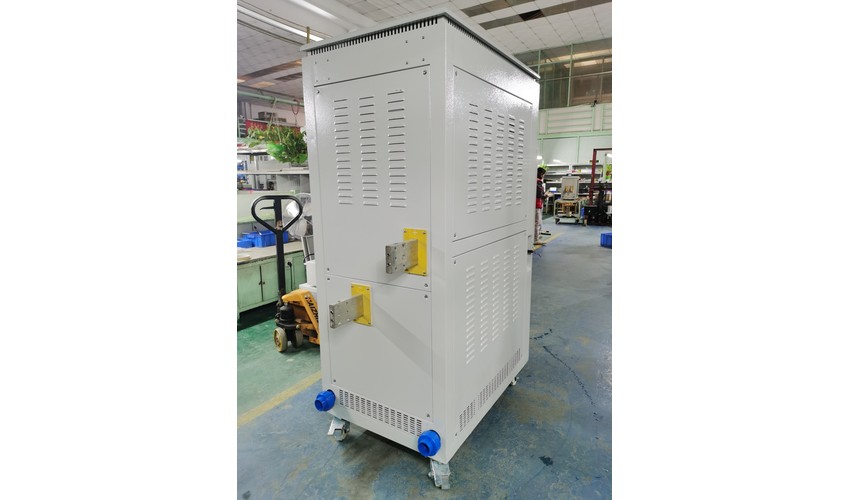
Technical Deep Dive: The 3000A 100V Air-Cooled Specification
For facilities prioritizing modularity and lower maintenance, the air-cooled 3000A 100V unit represents the pinnacle of balance between power density and ease of service.
- Capacity Considerations: 300kW of total output power is sufficient to drive large-scale electrocoagulation (EC) or electro-oxidation (EO) reactors handling thousands of gallons per hour.
- Thermal Management (Air Cooling): Unlike liquid-cooled systems that require complex plumbing, heat exchangers, and the risk of coolant leaks, air-cooled units leverage advanced heat sink designs and smart-variable speed fans. In 2026, top-tier air-cooled units utilize smart-fan logic that correlates power output with ambient thermal profiles, reducing energy consumption during low-demand periods.
- Control Interface: A professional-grade supply must feature an industrial PLC interface (Modbus TCP/IP or Profinet) to enable seamless integration into the plant’s Distributed Control System (DCS).
Buyer’s Guide: What to Look for in 2026 Procurement
When sourcing a 3000A 100V supply, the ‘cheapest’ option is rarely the most cost-effective. Procurement managers should evaluate vendors based on these four pillars:
1. Harmonic Distortion & Power Factor Correction (PFC):
Modern grids are sensitive. Ensure the power supply includes active PFC to maintain a power factor >0.95. This prevents costly penalties from utility providers for harmonic noise on the electrical network.
2. Modularity and Scalability:
Look for a design that allows for ‘parallel operation.’ If your plant expands, you should be able to synchronize two or more 3000A units to act as a single master-slave system. This future-proofs your investment.
3. Environmental Ruggedization:
Since EWT environments are often humid and chemically aggressive, ensure the enclosure is rated at least IP54. Look for conformal coating on internal PCBs to prevent corrosion from airborne particulates typical in treatment plants.
4. Advanced Diagnostic Telemetry:
In 2026, predictive maintenance is standard. Your unit should track ‘Hours of Operation,’ ‘IGBT temperature trends,’ and ‘Voltage Ripples.’ If a ripple exceeds a 1% threshold, the system should trigger a warning before a process shutdown occurs.
The ROI Equation: Moving Beyond CapEx
Calculating the Return on Investment (ROI) for an electrochemical power supply requires looking at the Total Cost of Ownership (TCO) over a 5–7 year horizon.
- Energy Savings: A high-efficiency (94%+) switched-mode power supply compared to an older thyristor-based design can save a facility tens of thousands of dollars annually in electricity costs.
- Electrode Longevity: The primary ‘consumable’ cost in EWT is the electrode material. By using pulsed DC, you can expect an increase in electrode lifespan by 20–30% due to reduced fouling and uniform wear. This represents a massive reduction in operational expenditure (OpEx).
- Regulatory Avoidance: The cost of failing to meet discharge standards can reach into the millions in fines or facility closures. A reliable, high-precision power supply ensures the treatment system operates within the ‘golden window’ of chemical removal efficiency 24/7.
2026 Industrial Trends: AI and Autonomy
Looking toward the remainder of the decade, the landscape of water treatment is shifting toward ‘Self-Optimizing Reactors.’
- AI-Driven Power Injection: Vendors are now integrating AI-ready firmware. These systems can ‘learn’ the conductivity of incoming water and adjust the pulsed waveform automatically. If the water becomes more conductive, the unit scales back current to save energy; if contaminants spike, the system ramps up instantly.
- Green Hydrogen Synergies: As many water treatment facilities integrate hydrogen production from wastewater (via electrolysis), the dual-purpose utility of 3000A power supplies is gaining traction. Procurement departments are now favoring units that are certified for both EWT and electrolytic hydrogen production, maximizing asset utilization.
- ESG Reporting: Modern power supplies now provide ‘Carbon Data Exporting.’ By logging the exact kilowatt-hours consumed per cubic meter of water treated, facilities can report precise environmental impact data to regulatory bodies and stakeholders, a growing requirement for ESG (Environmental, Social, and Governance) transparency.
Conclusion: Strategic Sourcing
Investing in a 3000A 100V air-cooled pulsed DC power supply is a significant commitment. In the 2026 market, success isn’t just about the hardware—it’s about the intelligence, integration, and reliability of the unit.
Prioritize manufacturers who offer robust technical support, long-term warranty programs, and open-source communication protocols. By focusing on energy efficiency, electrode preservation, and system interoperability, you are not just buying a power supply; you are securing the operational efficiency of your water treatment infrastructure for the decade to come.
Whether you are upgrading a legacy plant or commissioning a new greenfield project, the transition to intelligent, pulsed DC technology is no longer an optional upgrade—it is the foundational requirement for competitive industrial water management.