
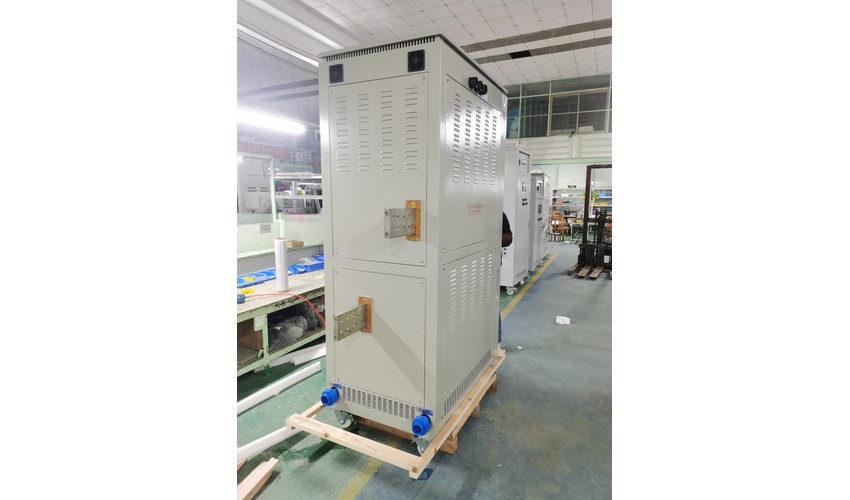
The Evolution of Electrolytic Power Infrastructure
Electrolysis lies at the heart of modern industrial chemistry, driving essential processes from chlor-alkali production and metal refining to the burgeoning field of green hydrogen generation. As the global demand for sustainable energy production intensifies, the role of the DC power supply for electrolysis has shifted from a mere supporting utility to a critical component of operational viability. For high-output applications requiring 1000A at 100V, traditional transformer-rectifier sets are rapidly being supplanted by advanced high-frequency switching technologies.
This article examines the engineering convergence of high-frequency power electronics and liquid-cooling thermal management, providing an exhaustive analysis of why these specifications are the new benchmark for industrial efficiency.
High-Frequency Switching: The Efficiency Paradigm
Historically, electrolysis power supplies relied on Silicon Controlled Rectifier (SCR) or thyristor-based technology operating at line frequencies (50/60 Hz). While robust, these systems suffer from significant inherent drawbacks: high bulk, substantial energy dissipation through harmonic distortion, and poor power factor performance.
Modern electrolysis demands precision. By transitioning to high-frequency switching technology—utilizing Insulated Gate Bipolar Transistors (IGBTs) or Silicon Carbide (SiC) MOSFETs—power supplies can now operate at switching frequencies ranging from 20 kHz to 100 kHz. The advantages are multi-faceted:
- Reduction in Magnetic Mass: High-frequency operation allows for the use of ferrite-core transformers rather than massive iron-core inductors. This drastically reduces the physical footprint of the unit, allowing for modular installation in space-constrained industrial facilities.
- Minimized Harmonic Distortion: High-frequency switching circuits are inherently capable of near-unity power factor correction. By minimizing reactive power draw, these units ensure that the input current remains clean, thereby reducing the burden on facility electrical grids and preventing penalties from energy utility providers.
- Superior Transient Response: Electrolysis processes often require rapid adjustments to current density to account for electrolyte concentration fluctuations or electrode degradation. High-frequency digital controllers can adjust output voltage and current in microseconds, a feat impossible for legacy analog-controlled thyristor systems.
Thermal Engineering: The Case for Water Cooling at 100kW
A 1000A/100V output represents a continuous power delivery of 100 kW. Managing the thermal load generated by such high-density power conversion is the defining challenge of modern power supply design. Air-cooled systems are often insufficient for this capacity, as they require large heat sinks and high-velocity fans that introduce contaminants (dust, humidity, chemical vapors) into the delicate electronics chamber.
Water-cooled architectures are the gold standard for high-performance electrolysis. By circulating a deionized water/glycol mixture through internal cold plates, the heat generated by the semiconductor switches is extracted directly from the source. This provides several technical advantages:
- Higher Power Density: Because liquid cooling is significantly more efficient at heat transfer than forced-air convection, the total surface area of the heat sink can be reduced. This allows designers to pack 100 kW of power into a significantly smaller chassis, reducing the total footprint of the electrolysis plant.
- Environmentally Sealed Design: The control circuitry and power modules can be housed in an IP54 or IP65-rated enclosure. This isolation prevents the entry of corrosive gasses—often prevalent in electrolysis environments—which would otherwise cause premature failure of printed circuit boards and electrical connections.
- Constant Operating Temperature: Consistent thermal regulation minimizes component drift, extending the Mean Time Between Failures (MTBF) and ensuring that the electrical output remains stable under varying ambient temperatures. This stability is critical for processes where current ripple must be minimized to ensure uniform product purity.
Energy Efficiency Standards and Sustainability
In the context of the global transition to net-zero, energy efficiency is no longer an optional performance metric; it is an economic and regulatory necessity. For a 1000A/100V system, even a 1% improvement in conversion efficiency can result in thousands of dollars in energy savings annually, depending on duty cycles.
Advanced power supplies now incorporate sophisticated digital control loops that allow for ‘Soft Switching’ or Zero Voltage Switching (ZVS) techniques. These topologies significantly reduce the switching losses that typically occur at high frequencies. When combined with high-grade components—such as low-ESR capacitors and high-conductivity busbars—these systems frequently achieve overall electrical efficiencies exceeding 94–96%.
Furthermore, the integration of smart-monitoring systems allows operators to track efficiency trends in real-time. By connecting the power supply to a plant-wide Industrial Internet of Things (IIoT) ecosystem, operators can optimize output based on real-time grid pricing or electrode impedance monitoring, effectively transforming the power supply into an active participant in the plant’s operational strategy.
Addressing Common Challenges in Electrolysis Power
Despite the clear advantages, implementing high-frequency power supplies for electrolysis requires careful consideration of the specific electrochemical load. Electrolytic cells act as non-linear loads with highly variable resistance.
- Current Ripple Management: Low ripple is essential for preventing localized overheating of electrodes and ensuring steady-state reaction kinetics. High-frequency systems, by their nature, allow for more effective output filtering, leading to ripple currents as low as <1% RMS.
- Durability and Maintenance: While water-cooling adds complexity to the site infrastructure, modern systems feature advanced flow-monitoring and leakage detection systems. These safety interlocks protect the power supply from cavitation or coolant loss, ensuring that the system shuts down gracefully before damage can occur.
Conclusion: The Future of Industrial DC Power
The shift toward 1000A/100V water-cooled, high-frequency DC power supplies represents a technological maturation of the electrolysis industry. As facilities look to scale their production—whether for chemical manufacturing or hydrogen synthesis—the investment in high-efficiency, liquid-cooled power conversion is the most effective path toward reducing operational expenditure (OPEX) and improving system reliability.
By prioritizing energy efficiency standards and adopting high-frequency switching technology, industrial engineers can ensure that their electrolytic processes are not only high-performing but also fully aligned with modern standards for sustainability and grid integration. As these power solutions become the industry baseline, the focus will continue to evolve toward modularity, intelligence, and the seamless integration of renewable energy sources into the DC bus, securing the future of efficient industrial electrolysis for decades to come.