
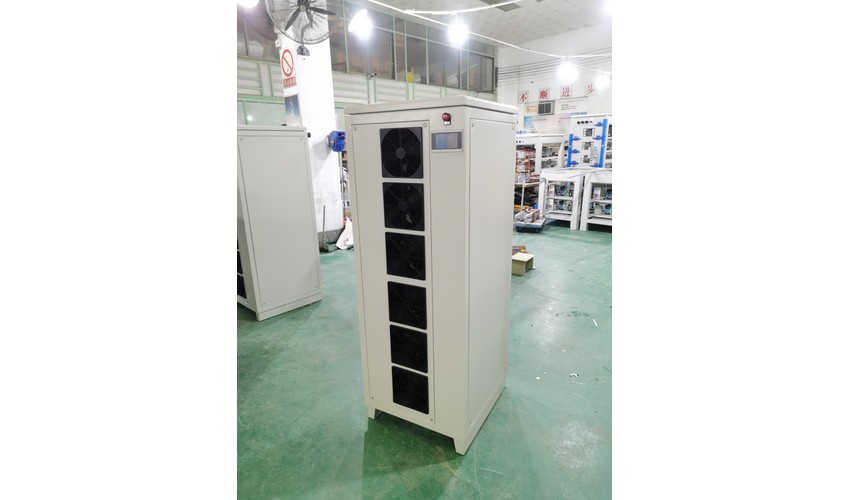
In the modern industrial landscape, the demand for precision, density, and efficiency in power conversion has reached a historical zenith. As manufacturing processes evolve toward greater automation and electrification, the reliance on robust Energy Conversion (EC) power systems has become the backbone of operational success. Among the leaders in this specialized sector, GAOHUI has emerged as a vanguard, particularly with its high-capacity 1000A 48V water-cooled power solutions. This article examines the technical architecture of these systems, focusing on the critical roles of high-frequency switching and thermal management in achieving superior energy efficiency standards.
The Shift Toward High-Frequency Switching
At the heart of the GAOHUI 1000A 48V architecture lies the paradigm of high-frequency switching. Traditionally, power conversion systems utilized lower-frequency switching, which necessitated large, heavy magnetic components—transformers and inductors—to filter the output. These components not only increased the physical footprint of the power supply but also introduced significant parasitic losses.
GAOHUI’s integration of advanced wide-bandgap (WBG) semiconductors, such as Silicon Carbide (SiC) or Gallium Nitride (GaN) components, allows for switching frequencies that far exceed conventional standards. By elevating the switching frequency, the energy stored in the magnetic components per cycle is reduced, enabling the use of smaller, more efficient transformers. This miniaturization does not come at the expense of power delivery; rather, it permits a higher power density, allowing 1000A of current to be delivered within a remarkably compact chassis. Furthermore, high-frequency operation allows for faster control loop responses, ensuring that the 48V output remains stable even under rapidly fluctuating load conditions typical in electrolysis, electroplating, or heavy-duty motor drive applications.
The Critical Necessity of Water-Cooled Architecture
While high-frequency switching minimizes core losses, the sheer density of a 1000A system presents a formidable thermal challenge. Convection cooling, while simpler, is often insufficient for maintaining the temperature stability required for long-term component longevity and efficiency. This is where GAOHUI’s water-cooled design proves its industrial value.
Water possesses a significantly higher thermal conductivity than air. By circulating a coolant directly through the heat sinks integrated with the power modules, the GAOHUI system effectively transports heat away from the switching components and capacitors. This active thermal management achieves two primary industrial objectives:
- Component Longevity: High temperatures are the primary catalyst for the degradation of electrolytic capacitors and semiconductors. By maintaining a lower and more consistent operating temperature, GAOHUI systems significantly extend the Mean Time Between Failures (MTBF), reducing downtime and maintenance overhead for industrial facilities.
- Efficiency Optimization: The internal resistance of semiconductor components increases with temperature (a phenomenon known as the positive temperature coefficient of resistance). By keeping these components cool, GAOHUI minimizes resistive losses, thereby directly increasing the conversion efficiency of the power unit.
Energy Efficiency Standards in Modern Manufacturing
Efficiency is no longer merely an operational goal; it is a regulatory requirement and a financial imperative. With electricity costs representing a significant portion of OpEx in heavy industry, the efficiency rating of a power supply can determine the profitability of an entire production line.
GAOHUI’s EC power systems are engineered to meet and exceed modern energy standards. By minimizing the heat dissipation through the combination of advanced topology and water cooling, these units consistently achieve high efficiency ratings—often exceeding 95% at nominal load. This efficiency is reflected in the ‘Cool to Power’ ratio, where the energy diverted to heat is minimized, ensuring that the maximum percentage of grid power is converted into usable 48V DC output.
Furthermore, GAOHUI incorporates intelligent power factor correction (PFC) and harmonic mitigation techniques. In a 1000A environment, reactive power and harmonic distortion can cause massive stress on the facility’s electrical grid. By cleaning the input power and ensuring a near-unity power factor, GAOHUI systems ensure compliance with international grid codes and reduce the stress on the facility’s distribution infrastructure.
Advanced Control and Monitoring
Beyond the hardware, the ‘EC’ (Energy Conversion) in GAOHUI’s systems refers to the sophisticated digital control layer. A 1000A 48V unit is essentially a precision instrument. GAOHUI utilizes high-speed Digital Signal Processors (DSPs) to monitor current and voltage levels with microsecond latency. This digital control allows for:
- Precise Output Regulation: Maintaining a rock-solid 48V output even during high-transient events.
- Predictive Diagnostics: By monitoring current ripples and thermal profiles, the control system can identify potential anomalies before they manifest as failures, enabling predictive rather than reactive maintenance.
- Scalability: GAOHUI systems are designed with modularity in mind. Multiple 1000A units can be paralleled using master-slave synchronization, allowing industries to scale their power capacity seamlessly as production requirements grow.
Industrial Applications and Future Proofing
The application scope for the GAOHUI 1000A 48V water-cooled system is extensive. In the metal finishing industry, such as large-scale chrome or nickel plating, the precision of the current ensures uniform deposit thickness, reducing waste and scrap rates. In hydrogen production, via electrolysis, the efficiency of the DC power supply dictates the cost-per-kilogram of hydrogen generated. In electric vehicle battery manufacturing, the stability of the charging profiles is critical to ensuring the health and performance of the battery cells.
As the industrial sector moves toward ‘Industry 4.0,’ the integration of these power systems into existing Fieldbus and IoT ecosystems is paramount. GAOHUI has anticipated this, incorporating communication interfaces that allow operators to monitor energy consumption, voltage stability, and thermal health from centralized control rooms. This connectivity, combined with the inherently high energy efficiency of the platform, positions GAOHUI not just as a power hardware provider, but as a strategic partner in the transition to more sustainable industrial practices.
Conclusion
The choice of a power conversion system in a high-current environment is a decision that impacts the facility’s entire energy profile. GAOHUI’s 1000A 48V water-cooled EC power system represents the intersection of high-frequency switching agility and robust thermal management. By reducing physical size, increasing conversion efficiency, and providing the diagnostic intelligence required for modern operations, GAOHUI provides a comprehensive solution for companies looking to optimize their energy consumption. In an era where efficiency, reliability, and precision define the competitive edge, investing in high-performance EC power technology is not merely an option—it is a necessity for the modern industrial powerhouse.