
Optimizing Industrial Wastewater Treatment: The Critical Role of Electrochemical Power Supplies
Industrial wastewater, often laden with complex pollutants, poses significant environmental challenges. Conventional physical, chemical, and biological treatment methods, while effective for many contaminants, can struggle with recalcitrant organic compounds, heavy metals, and high salinity. Electrochemical processes have emerged as robust, efficient, and environmentally friendly alternatives, offering superior pollutant removal capabilities. The success and efficiency of these electrochemical treatments, however, fundamentally hinge on the performance of their dedicated power supplies. These power supplies are not merely rectifiers; they are sophisticated systems designed to deliver precise electrical parameters crucial for driving specific electrochemical reactions.
The Role of Electrochemical Processes in Wastewater Treatment
Electrochemical wastewater treatment methods leverage direct or indirect electrochemical reactions to transform or remove pollutants. Key processes include:
- Electrocoagulation (EC) and Electroflocculation (EF): These methods use sacrificial electrodes (e.g., aluminum or iron) to generate coagulant species in situ, which destabilize pollutants and form flocs that can be easily separated. The power supply must provide a stable DC current to ensure consistent electrode dissolution. Pulse modes, often seen in ‘Single Pulse Electrocoagulation Power Supplies,’ can enhance floc formation and reduce passivation.
- Electrocatalytic Oxidation (EO): Involves the direct oxidation of organic pollutants at the anode surface or indirectly via electrochemically generated strong oxidants (e.g., hydroxyl radicals, active chlorine). ‘Electrocatalytic Oxidation Power Supplies’ require highly stable and controllable DC output, often at moderate voltages, to optimize radical generation and minimize side reactions.
- Electro-Fenton: An advanced oxidation process where ferrous ions and hydrogen peroxide (often generated electrochemically) react to form highly reactive hydroxyl radicals. Dedicated ‘Electro-Fenton Power Supplies’ are crucial for maintaining optimal conditions for radical production.
- Electrodialysis (ED): Utilizes ion-exchange membranes and an electric field to separate ions from water, commonly used for desalination or selective ion removal. ‘Electrodialysis Power Supplies’ often incorporate automatic periodic reverse polarity functions to prevent membrane fouling and maintain efficiency.
- Electrolytic Descaling: A process that uses electrolysis to remove scale deposits from equipment, often utilizing specific power supply characteristics to drive the descaling reaction.
Key Features of Specialized Electrochemical Power Supplies
For industrial applications, electrochemical power supplies are engineered with specific characteristics to meet the demanding requirements of continuous operation and precise control:
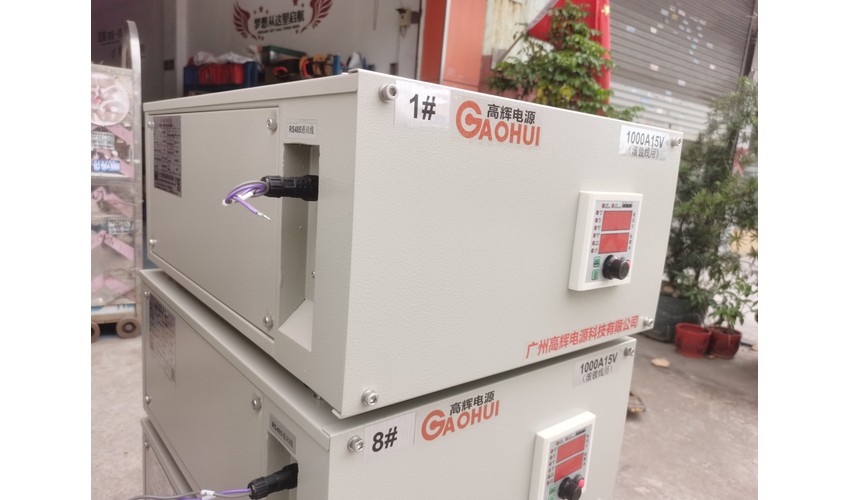
- Output Parameters: Industrial power supplies must deliver stable and adjustable DC current and voltage. Typical current ratings range from 100A for smaller systems or high-voltage applications (like Electrodialysis) to 1000A and above for high-volume processes such as Electrocoagulation or Electrocatalytic Oxidation. Voltage outputs vary widely, from 10V-24V for many oxidation processes to 100V for Electrodialysis or specific descaling applications.
- Control Mechanisms: Advanced power supplies offer constant current (CC) and constant voltage (CV) modes. Crucially, many feature intelligent control panels or remote control heads, allowing for precise parameter adjustment, monitoring, and automated operation. The inclusion of ‘Automatic Periodic Reverse Polarity Power Supplies’ significantly extends electrode and membrane lifespan by preventing passivation and fouling. ‘Single Pulse Power Supplies’ are designed to optimize reaction kinetics and mass transfer in certain processes.
- Efficiency and Cooling: High-frequency switching technology, often utilizing ‘High-Frequency Rectifiers’ or ‘Synchronous Rectifiers,’ ensures high energy conversion efficiency, reducing operational costs and heat generation. Robust ‘Air-cooled’ systems, often incorporating multiple fans (e.g., 2, 3, 4, or 6 fans depending on power output), are standard for dissipating heat, ensuring reliability and longevity in harsh industrial environments.
- Monitoring and Safety: Comprehensive monitoring of output parameters, temperature, and fault conditions is essential. Built-in protection against overcurrent, overvoltage, short circuit, and overheating ensures operator safety and equipment integrity.
Typical Power Supply Specifications for Wastewater Applications
The choice of power supply is critical and depends on the specific electrochemical process and its operational demands. Below is a summary of typical power supply specifications:
| Application | Typical Current Range | Typical Voltage Range | Key Features |
|---|---|---|---|
| Electrocoagulation (EC)/Electroflocculation (EF) | 1000A – 2000A+ | 10V – 24V | Constant Current/Voltage, Single Pulse, Intelligent Control, Air-cooled |
| Electrocatalytic Oxidation (EO) | 1000A – 2000A+ | 12V – 24V | Stable DC, Intelligent Remote Control, High-frequency Rectification |
| Electro-Fenton | 1000A – 2000A+ | 18V (Dedicated) | Stable DC, Precise Voltage/Current Control, Intelligent Remote |
| Electrodialysis (ED) | 100A – 500A | 50V – 100V | Automatic Periodic Reverse Polarity, Intelligent Control Panel |
| Electrolytic Descaling | 100A – 500A | 50V – 100V | Dedicated Application, Intelligent Remote Control |
Conclusion
Electrochemical power supplies are indispensable components in modern industrial wastewater treatment. Their ability to deliver precise, stable, and controllable electrical energy directly impacts the efficiency, reliability, and cost-effectiveness of electrochemical processes. As industries face increasing pressure to meet stringent environmental regulations, the demand for advanced, energy-efficient, and intelligently controlled electrochemical power supplies will continue to grow. Investing in the right power supply is not just about powering an electrochemical reactor; it’s about ensuring optimal pollutant removal, extending equipment lifespan, and achieving sustainable wastewater management outcomes.