
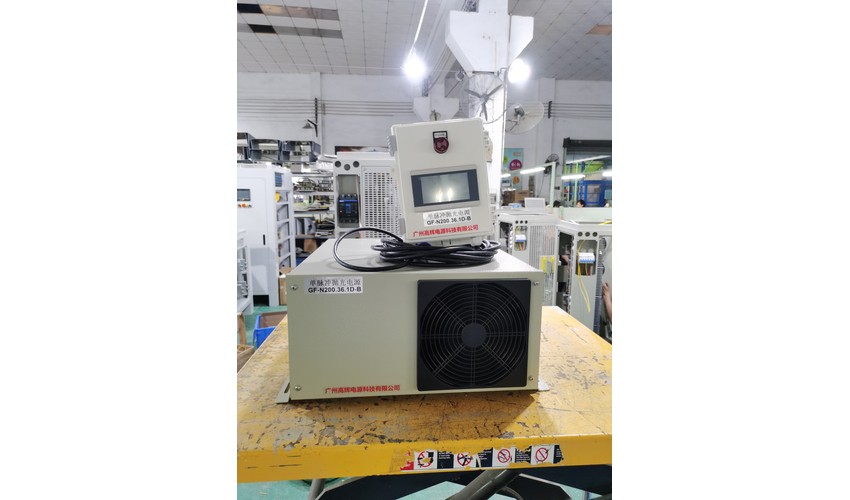
Industrial wastewater treatment faces the complex challenge of removing diverse contaminants efficiently and cost-effectively. Electrocoagulation (EC) has emerged as a promising alternative, offering benefits such as reduced sludge volume, no chemical addition, and effective removal of heavy metals, suspended solids, and emulsified oils. Central to the success and efficiency of any EC system is its power supply – a component far more critical than a mere electricity source. This article delves into the technical aspects of electrocoagulation power supplies, highlighting their design considerations and impact on industrial wastewater treatment.
Understanding Electrocoagulation (EC)
Electrocoagulation (EC) is an electrochemical process using electricity to destabilize pollutants. It involves sacrificial anodes (iron or aluminum) and cathodes. When DC is applied, anodes release metal ions which hydrolyze into coagulants. These coagulants destabilize pollutants, forming flocs. Hydrogen gas bubbles at the cathode aid in floc flotation, enhancing separation from treated water.
The Critical Role of the Power Supply
The EC power supply is more than a simple AC-DC converter; it controls the electrochemical process. Its characteristics directly influence electrode dissolution, coagulation efficiency, energy consumption, and electrode longevity. Improper specification leads to inefficient treatment, high costs, rapid passivation, and unreliable operation. A well-designed power supply ensures optimal contaminant removal, maximizes electrode lifespan, and minimizes operational expenditure.
Key Characteristics of an Ideal EC Power Supply
- Precise Voltage and Current Control: EC relies on DC. Constant current operation is preferred for consistent metal ion release and predictable coagulation, regardless of water conductivity or electrode surface. This allows fine-tuning treatment for varying wastewater compositions.
- Polarity Reversal Functionality: Electrode passivation and scaling degrade EC performance. Automatic polarity reversal periodically swaps electrode functions. This self-cleaning mechanism extends electrode lifespan, maintains efficiency, and reduces maintenance needs.
- Duty Cycle Control (Pulsed Power): Pulsed DC can enhance floc formation, reduce energy consumption, and mitigate passivation. The “off” period allows time for diffusion, potentially leading to more robust flocs with lower energy input for similar treatment.
- Overload and Short-Circuit Protection: Robust protection against overcurrents, overvoltages, and short circuits is essential. This ensures operational safety and protects the power supply, electrodes, and components from damage in industrial environments.
- Advanced User Interface and Automation: Modern EC power supplies feature intuitive HMIs for monitoring and adjustment. SCADA integration enables remote monitoring, data logging, and automated control, enhancing operational efficiency and reliability.
Power Supply Topologies for EC
The internal architecture of the power supply also plays a significant role in its performance characteristics:
- Thyristor/SCR Rectifiers: Traditional, robust, and often less expensive. However, less efficient and offer less precise control over ripple compared to newer technologies. Power factor correction can also be a concern.
- Switch-Mode Power Supplies (SMPS) / IGBT-based Rectifiers: Modern EC systems increasingly use high-frequency SMPS, often with IGBTs. These offer high energy efficiency (>90%), precise control, lower ripple, smaller footprint, and better power factor correction, optimizing EC performance and reducing operational costs.
Factors to Consider When Selecting an EC Power Supply
Choosing the right EC power supply requires careful consideration of application-specific factors:
- Wastewater Characteristics: Conductivity, volume, and contaminant types dictate required voltage, current range, and electrode material.
- Treatment Goals: Desired removal efficiency and throughput directly influence necessary power output and control precision.
- Energy Efficiency: An efficient power supply (e.g., SMPS-based) leads to significant long-term savings.
- Budget and Operational Costs: Balance initial investment with projected energy consumption, maintenance, and electrode replacement costs.
- Scalability and Integration: Assess future expansion needs and integration with existing plant automation.
To summarize some key aspects:
| Feature | Impact on EC Process |
|---|---|
| Constant Current Control | Consistent metal ion release, predictable coagulation rate. |
| Polarity Reversal | Extends electrode lifespan, prevents passivation/scaling, maintains efficiency. |
| Pulsed Power | Reduced energy consumption, enhanced floc formation, improved efficiency. |
| High Efficiency Topology (SMPS) | Lower operational costs, reduced heat generation, smaller footprint. |
In conclusion, the electrocoagulation power supply is a pivotal component for successful industrial wastewater treatment. Its sophisticated design, integrating precise control, automatic polarity reversal, pulsed power, and automation, transforms it into an intelligent process controller. Selecting an appropriate, high-quality power supply is crucial for achieving optimal treatment efficiency, minimizing operational costs, extending electrode lifespan, and ensuring sustainable, reliable operation of EC technology in diverse industrial applications.